Mentoring Moment: Building Trust Through the MENTOR Model: Creating Psychological Safety in Every Conversation

By: Tracy Rogness, Organizational Stewardship Lead, and Tina Henne, Early Career Development Lead

Psychological safety is an individual’s mental and emotional state, shaped on how they perceive and respond to their environment, and free from interpersonal fear. Silence is only one visible symptom of low psychological safety, while many others remain hidden in the form of mental withdrawal, emotional suppression, and subtle avoidance behaviors. It’s a critical element in fostering trust, collaboration, and growth in any relationship, especially in mentoring. When both mentors and mentees have high levels of psychological safety, they feel empowered to be authentic, share vulnerabilities, and engage in open, honest dialogue. This creates a foundation for deeper learning and mutual development.

The MENTOR model is a thoughtful framework designed to foster psychological safety and create meaningful, transformative mentoring relationships. Each component of the model represents a key principle that mentors can use to guide their interactions and build trust with their mentees. Here’s a deeper dive into each element:

M – Mindset

A mentor’s mindset shapes how the brain interprets social cues and sets the tone for the entire relationship. Approaching the mentoring with openness, curiosity, and humility reduces cognitive rigidity and supports a more accurate understanding of the mentee’s experiences. Instead of approaching the relationship as a one-way transfer of knowledge, mentors should see it as a dynamic, collaborative learning process where both people grow and learn. A learning-oriented mindset allows mentors to remain flexible, adapt to the mentee’s needs, and approach challenges as opportunities for shared development.

Key Actions:

  • Be open to new perspectives and ideas.
  • Approach conversations with curiosity, asking questions to understand rather than to judge.
  • Recognize that mentoring is a two-way street where both mentor and mentee can learn.

E – Empathy

Empathy is the cornerstone of psychological safety because it reduces social-evaluation threat and helps regulate the other person’s emotional state. When mentors are fully present, listen deeply, and respond with care, they signal that the mentee is safe from judgment. Rather than rushing to solve problems or offer advice, effective mentors focus on accurately understanding the mentee’s experiences and emotions. This attuned, validating response activates a sense of being seen, heard, and supported, making it easier for the mentee to share openly and engage in meaningful learning.

Key Actions:

  • Listen without interrupting or jumping to conclusions.
  • Validate the mentee’s feelings and experiences without minimizing them.
  • Avoid over-relating by saying things like “I understand” unless you truly do.

N – Nurture

Mentors nurture growth by fostering intrinsic motivation and learning. When they encourage exploration, invite self-reflection, and offer constructive feedback, they activate the psychological needs for autonomy, competence, and relatedness that drive sustained development. A supportive mentoring environment reduces performance pressures, increases confidence, and helps mentees build the skills and resilience needed to navigate challenges effectively.

Key Actions:

  • Encourage the mentee to explore new ideas and approaches.
  • Provide thoughtful, actionable feedback that promotes growth.
  • Celebrate progress and milestones, no matter how small.

T – Trust

Trust is the foundation of any successful mentoring relationship because it reduces social vigilance and signals that the relationship is safe from judgment or harm. When mentors are consistent, honest, and transparent, they create predictability that the brain relies on to lower the threat response. This sense of reliability makes it easier for mentees to share challenges, vulnerabilities, and aspirations, opening the door to deeper learning and authentic connection.

Key Actions:

  • Be reliable and consistent in your actions and communication.
  • Create a judgment-free zone where the mentee feels safe to express themselves.
  • Be honest and transparent, even when discussing difficult topics.

O – Opportunity

Mentors expand opportunity by creating the condition that stretch a mentee’s capabilities without overwhelming them. When they offer meaningful challenges, sharing resources, and encouraging deliberate skill-building, they place the mentee in an optimal learning zone where growth is most likely. This balance of support and challenge increases confidence, strengthens competence, and helps mentees recognize and pursue new opportunities they may not have seen on their own.

Key Actions:

  • Identify and share opportunities that align with the mentee’s goals and interests.
  • Encourage the mentee to step out of theircomfort zone and take on new challenges.
  • Support the mentee in developing the skills and confidence needed to seize opportunities.

R – Respect

Respect strengthens psychological safety by signaling that a mentee’s identity, insights, and lived experiences are valued rather than judged. When mentors recognize the mentee’s potential and engage with them as an equal partner, they reduce the social-evaluation threat that can limit openness and learning. Respect also means avoiding assumptions, staying curious about the mentee’s perspective, and fostering a sense of mutual appreciation that supports authentic, trusting connection.

Key Actions:

  • Acknowledge the mentee’s unique strengths and contributions.
  • Avoid imposing your own assumptions or biases on the mentee.
  • Foster a culture of mutual respect and collaboration.

Bringing It All Together

When mentors embody the MENTOR model, they create conditions where psychological safety can take root and grow. This allows for open, honest, and meaningful conversations that fuel personal and professional development. By grounding their interactions in mindset, empathy, nurture, trust, opportunity, and respect, mentors transform their relationships into catalysts for lasting growth.

The MENTOR model is more than a set of principles for mentoring; it’s a guide for building stronger, more authentic connections in every part of life. Whether you are mentoring a colleague, leading a team, or simply having a conversation, these practices help you create spaces where everyone feels valued, heard, and empowered to thrive.


Mentoring Moment: Your Personal Growth Team: Go Beyond Traditional Mentorship for Your Professional Development

By: J.D. Horst, CSP, LEAN6σ – Occupational Health and Safety Manager

When it comes to personal and professional growth, we often hear about the importance of mentorship. And while having a mentor is undeniably valuable, it’s not the only way to grow. In fact, relying on just one person for guidance can sometimes limit your potential. That’s why I want to share a concept that has completely changed the way I approach my own development: building a personal growth team.

Think of it as creating your own support system. A group of people, resources, and tools you can turn to for advice, encouragement, and fresh perspectives. By surrounding yourself with diverse sources of guidance, you can thrive in every area of your life.

Why Go Beyond Traditional Mentorship?

Mentorship is a wonderful thing. A mentor can guide you, share their experiences, and help you navigate challenges. But here’s the catch: mentorship often has its limits. Maybe your mentor’s expertise doesn’t align with all your goals, or perhaps the relationship naturally comes to an end. That’s where the idea of a personal growth team comes in. It’s about expanding your support system and creating a network that helps you grow in multiple areas.

What Is a Personal Growth Team?

Imagine having a network of people and resources dedicated to helping you grow. Your team doesn’t need to meet in person, or even consist solely of individuals. It can include tools, knowledge sources, or trusted advisors you’ve intentionally selected to support specific areas of your life. Whether it’s career advancement, financial management, leadership development, personal wellness, or any other area you choose, your team serves as a guide to help you achieve your goals.

How to Build Your Team

Here’s the fun part: building your team is entirely up to you. Start by identifying the areas where you want to grow—your focus areas. For example, maybe you want to improve your leadership skills, learn more about financial planning, or find balance in your family life. Once you’ve pinpointed your goals, think about who (or what) can help you.

Your team might include:

  • Mentors: Traditional mentors are still incredibly valuable. Whether it’s someone you admire at work or a mentor you connect with through a formal program, their guidance can be a cornerstone of your growth.
  • Books and Podcasts: Sometimes, the best advice comes from experts you’ve never met. Dive into books or listen to podcasts that align with your goals.
  • Courses and Certifications: Whether it’s a LinkedIn Learning course or a certificate program, structured learning can help you develop specific skills.
  • Conferences and Networking Events: Industry events are a goldmine for learning and connecting with like-minded professionals.
  • Your Supervisor: Don’t underestimate the value of open conversations with your boss. They can offer insights into your career path and suggest areas for development.

The beauty of this approach is that your team can be as diverse as you want it to be. It’s not about finding one perfect person. It’s about creating a network of resources that collectively support your professional development.

Setting Expectations

Once you’ve assembled your team, it’s important to establish what you hope to gain from each member. For example, you might turn to a mentor for career advice, rely on a podcast for inspiration, or use a course to build technical skills. Be clear about your goals and, when appropriate, communicate your expectations. And don’t forget, this is a two-way street. Value the time and insights your team members provide and hold yourself accountable for taking action on their advice.

Reflecting on Your Growth

One of the most powerful habits you can develop is regular self-reflection. Ask yourself questions like:

  • What did I learn today?
  • How did I grow today?
  • What will I do differently tomorrow?

Your team isn’t set in stone. As you grow and your goals evolve, your team will change too. Some members may step away, and new ones will join. That’s the beauty of this approach, it’s flexible and tailored to your journey.

Take Charge of Your Development

Building a personal growth team is about taking ownership of your development. It’s a proactive, intentional way to ensure you’re always learning, improving, and moving toward your goals.

So, why not start today? Think about the areas where you want to grow, identify the resources and people who can help, and begin building your team. With the right support system in place, there’s no limit to what you can achieve.

Mentoring Moment: Make 2026 the Year of Curiosity!

The audience listened intently as Claus Daniel, Associate Laboratory Director for Advanced Energy Technologies, delivered the keynote address at the 2025 Postdoctoral Research and Career Symposium. Claus emphasized the importance of asking good questions to maximize the power of mentorship and recommended The Book of Beautiful Questions by Warren Berger. His remarks reminded me of one of the biggest hurdles people face when beginning a new mentoring relationship:

What are we going to talk about?

We define mentoring as a collaborative learning relationship built on trust, where mentors share their knowledge and experiences to help mentees reach their full potential. Collaboration requires dialogue, which means both mentor and mentee must be active participants in the conversation.

So how do we ensure we are having productive, meaningful conversations that foster learning?

In a mediation skills course, I learned that good conversations benefit when we are calm, open, and curious. Let’s look at each of these.

Be calm

Being calm doesn’t mean you expect a conversation to be confrontational. On the contrary, it allows you to clear your mind and consider what the other person is saying before you respond.

A few simple ways to stay calm before and during a conversation are:

  • Take a few slow, deep breaths.
  • Pause briefly before responding.
  • Assume the other person is coming from a place of goodwill or positive intent.

Be open

Once you are calm, you are in a better position to be open. Open to what?

Be open to other points of view, to making mistakes, to new ideas, and to unexpected questions. In short, be open to learning.

Be curious

Curiosity is a key skill in mentoring—for both mentors and mentees. Mentees need to ask questions to get the mentoring they need, and mentors need to ask questions to understand how best to support and guide their mentees. Curiosity prompts us to want to know more.

To unleash your inner curiosity, ask open-ended questions—questions that invite more than just a yes-or-no answer and encourage true dialogue. Asking good questions is a powerful tool to foster learning.

What kinds of questions help?

Randy Emelo, author at River Software for mentoring solutions, writes in Ask Me Anything: The Power of Questions in Learning that we should tap into the same curiosity we had as children, when everything was about discovery and learning.

What do you want to know about your mentor or mentee?

  • What mistakes have they made?
  • What successes have they enjoyed?
  • What were the circumstances around those experiences?

In addition to The Book of Beautiful Questions, there are countless examples of questions to ask your mentor or mentee available with a quick online search. For example, this article by Mentorloop offers 73 questions to ask your mentor or mentee, grouped by stages of the mentoring relationship.

Give it a read, and then be calm, be open, and be curious.

And have yourselves some great conversations.

Resiliency in the Workplace

To celebrate National Mentoring Month, we are featuring a series of guest posts reflecting on mentorship. This week’s feature from Shanissa Bell, Leadership Development Programs Lead with the Argonne Leadership Institute, writes about an important topic and one where mentors are critical–resiliency!

Do you sometimes struggle with adapting to the never-ending changes in your work environment? Are you looking for ways to balance frequent churn with your need to be productive or to achieve success? If you answer yes to either of these questions, you are not alone. According to the 2020 Workplace Resilience Study, “only 15% of workers worldwide exhibit high resilience” (ADP Research Institute, 2021). When we think about resilience in the workplace, we are really referring to an individual’s ability to fully adapt to challenges, change, and stressors. Being resilient in the workplace means that you have developed the skills to adjust and grow when you receive new and sometimes conflicting information or when dealing with changes in the organization or its structure.

In today’s world, employees are subjected to an immeasurable amount of pressure and uncertainty. Employees often deal with poor communication, lack of autonomy or support, and higher than average workloads. While it is important to understand what causes workplace stressors, it is equally important to recognize that your personal resiliency or your ability to ‘bounce back’ is a skill that can be improved.

Employees who are highly resilient have many characteristics in common that are worth exploring. Here are 4 examples of common traits in highly resilient people that can help you improve your own skills in these areas.

  1. Resilient employees have a positive outlook

Resilient employees not only have a positive outlook at work; they are also realistic about situations that are within their control and are aware of things that they are unable to change. These employees don’t fixate on uncertainty but instead look for opportunities to improve the situation.

How can you improve this skill? Concentrate on things that are in your control. You may need to shift your mindset from thinking about what you can’t do to what you are able to do. Try to remain positive and if you encounter a roadblock, bring other people in who can assist you in determining your next steps.

2. Resilient employees are flexible

Being able to pivot is necessary when dealing with change. Employees who are flexible tend to be open-minded and focus on their ability to switch between tasks quickly. This helps them adjust to fluctuations in their day-to-day tasks.

How can you improve this skill? As an employee you can develop your flexibility by taking on projects to learn new skills. You can also advocate learning from others on your team. You may even take on stretch assignments that allow you to work in areas that are not routine for your job. Doing these things will increase your skill base and allow you to take on new initiatives quickly.

3. Resilient employees have a sense of purpose

“Highly resilient people are 3.9 times more likely to love what they do” (ADP Research Institute, 2021). When an employee believes in the mission and the vision of the organization that they work for, they are more likely to want to see the organization succeed. This in turn increases the success of the employee.

How can you improve this skill? You can start by seeking to understand the goals of your organization. By understanding the mission and what the organization is working towards accomplishing, you can ensure that there is an alignment in your work and what you care about as an individual.

4. Resilient employees have strong social support

Employees who can work through challenging situations and succeed in the face of change have strong social networks. This is extremely important in the workplace. Resilient employees have peers, mentors, and leaders that they can confide in and ask for help when needed.

How can you improve this skill? Network, network, network! Expanding your social circle is a great way to deal with workplace stress and change.  You can build your network by attending both internal and external networking events, you can join an ERG or join a cross-functional project team. Taking these steps will help you build a network of supporters that can help you during challenging times.

Finally, while you may find it difficult to deal with uncertainty or ambiguity, there is a light at the end of the tunnel. Change is to be expected but you can increase your resiliency skills to help you adapt to future situations. Understanding what affects resiliency is the first step in creating a plan to productively decrease workplaces stressors while increasing your ability to succeed.


Sources:

ADP Research Institute. (2021, March 23). MIT Sloan Management Review: The Top 10 findings on Resilience and Engagement – ADP Research. ADP Research. https://www.adpresearch.com/assets/mit-sloan-management-review-the-top-10-findings-on-resilience-and-engagement/


Empathy in Action: The Crucial Role of Emotional Intelligence in Effective Mentorship

To celebrate National Mentoring Month, we are featuring a series of guest posts reflecting on mentorship. This week’s feature from Jeremy Boldt, Manager, Learning and Organization Development with the Argonne Leadership Institute, discusses the role of emotional intelligence in mentoring.

Reflecting on my career in learning and development, as well as my mentoring experiences, both as a mentee and mentor, I’ve realized the importance of people over process. With nearly two decades in organizational learning and development, I’ve noticed a preference for structured processes and metrics. However, influenced by my humanities background (and borrowing a term from one of my Argonne colleagues), I recognize the value of the “squishy” aspects of development—those unmeasured elements that hinge on emotional intelligence.

Emotional intelligence, a concept explored through various models, highlights how our emotions and personalities impact our experiences. The Emotional Intelligence 2.0 model by Dr. Travis Bradberry and Dr. Jean Graves outlines four key skills: self-awareness, self-management, social awareness, and relationship management. These skills are crucial in mentoring:

  • Self-Awareness: Understand your motivations and reactions. Before seeking your mentor’s perspective on a work issue, reflect on your drivers to frame the conversation effectively.
  • Self-Management: Use self-awareness to manage your reactions. If something bothers you, prepare mentally before discussing it with your mentor, fostering a more productive dialogue.
  • Social Awareness: Focus outward to appreciate others. In mentoring, strive to understand and value your partner, enhancing the relationship and mutual learning.
  • Relationship Management: View mentoring as a long-term relationship. Building and maintaining a strong connection requires effort, with both parties responsible for deepening the bond.

Consider these skills as part of a continuous journey: know yourself, manage yourself, understand others, and maintain connections. Mentoring will have its challenges, but embracing discomfort and seeking honest feedback can strengthen trust and foster a robust mentoring relationship.


Imposter Syndrome and Mentorship: Embrace Your Unique Experience

To celebrate National Mentoring Month, we are featuring a series of guest posts reflecting on mentorship. This week’s feature from Katherine Murphy, Employee Development Lead with the Argonne Leadership Institute, provides tips for overcoming imposter syndrome as mentors.

Have you ever thought about becoming a mentor, only for thoughts such as, “You’re not qualified enough” or “You don’t know enough” to pop up? If so, you’re not alone. These thoughts are a product of imposter syndrome, and they can sneak in at any point in your career, no matter how many accomplishments you have. The good news is that we can overcome this! Let’s look at how to tackle imposter syndrome and own your unique journey to be able to share all the incredible experience you have with a potential mentee.

Imposter Syndrome in Mentorship

Imposter syndrome is the inability of a person to see their successes and accomplishments as a result of their own effort.* They fear being exposed as a “fraud.” In mentorship, questions like “Do I have enough expertise?” or “What if I give the wrong advice?” are typical, as imposter syndrome plays on self-doubt. We can put a lot of pressure on ourselves and think that as mentors, we need to give the perfect advice and guidance. And then, doubt that we can do so. In reality, being a mentor isn’t about being perfect and inspiring, and these doubts can undermine the real value that you bring to a mentorship relationship.

 You Are Uniquely You – Your Experiences Are Valuable

In the words of Dr. Seuss, “Today you are you, that is truer than true. There is no one alive who is you-er than you.” One of the best ways to fight imposter syndrome is to embrace all the components that make you, you. No two mentors are alike. Your experiences, the good and the bad, have equipped you with insights that no one else has. Whether you’ve navigated complex career transitions, overcome personal challenges, or developed niche expertise, these experiences can be invaluable to a mentee.

Every mentor offers different perspectives, and that’s good, as every mentee has different needs. Consider this: a mentor who has recently navigated the early stages of their career may offer fresh, relatable advice to a mentee just starting out. On the other hand, a mentor with decades of experience can provide long-term strategic insights. Both perspectives are valuable and can significantly impact a mentee’s journey.

 Tips for Addressing Imposter Syndrome

If you are contemplating becoming a mentor or are currently a mentor but doubt your effectiveness, here are a few things you can do to change your mindset and see the value you bring to a mentorship relationship.

  1. Acknowledge Your Doubts: An important step in overcoming imposter syndrome is to acknowledge it and realize that many others share this experience. Recognize that these doubtful thoughts are not true.
  2. Focus on Your Strengths: Make a list of your strengths and accomplishments. When doubts creep in, review this list to remind yourself of the amazing skills and experiences you can draw from.
  3. Seek Feedback:  Feedback from your mentee and peers can provide valuable insights you wouldn’t otherwise have and help you understand your positive impact more clearly.
  4. Share Your Story: Open up to your mentee about your experiences and how you got to where you are, including where you may have doubts. This vulnerability can strengthen your connection and show your mentee that being less than perfect is okay.
  5. Keep Learning: Remember that mentorship is a two-way street. Being open to learning from your mentee relieves some of the pressure you may feel from thinking you need to be an expert.

Conclusion

Mentorship isn’t about having all the answers. It’s about sharing your experiences, offering guidance, and providing a new perspective. Your mentee will benefit from your unique insights, even if your initial thought is doubt.

Don’t let imposter syndrome take away your opportunity to make a meaningful impact. Your perspectives and willingness to pour into others are what qualifies you to be a great mentor. The best mentors continue to learn and grow alongside their mentees, recognizing that imperfection is part of the journey.

*“Impostor Syndrome, N.” Oxford English Dictionary, Oxford UP, September 2023, https://doi.org/10.1093/OED/3742536120.   

Leaders in Mentoring: When to Lead and When to Learn

To celebrate National Mentoring Month, we are featuring a series of guest posts reflecting on mentorship. This week’s feature from Shanissa Bell, Leadership Development Lead with the Argonne Leadership Institute, highlights how mentorship help us as leaders AND learners!

Leaders in organizations are often encouraged to become mentors for employees who are interested in topics such as honing technical skills, navigating advancement opportunities, and increasing their network reach and influence. Mentoring is a way for leaders to give back by sharing the knowledge that they have gained over the course of their career. Having the opportunity to participate in a mentoring relationship helps facilitate a mentee driven understanding of where you are versus where you want to be.

When most people think about leaders in mentoring, they automatically assume that the leader is cast in the role of the mentor. While this is true in many mentoring relationships, it is easy to overlook that leaders can benefit from having a mentor of their own. As a leader, it is important to think about both the development of others and your self-development needs. Whether or not you are the mentor, or the mentee is dependent upon where you are in your own development. When considering a mentorship role, ask yourself, is it time for me to lead or time for me to learn?

The Leader as a Mentor
Do you have advanced technical knowledge, or have you moved up through the organizational ranks to reach your current position? Do you have the time and energy to provide a beneficial relationship to a mentee? These are a few of the questions you can ask yourself to help determine if the role of a mentor is right for you.  Mentors are adept at giving back by sharing their individual journey and skills with others.  This transfer of knowledge is invaluable in helping employees explore their skills and future career paths in a one-one-one personalized setting. Mentors in this capacity must be willing and able to provide structured feedback based on personal experience and mentors should be committed to being available to their mentees as an advisor and sounding board. Becoming a mentor will allow you to help others expand their careers.

The Leader as a Mentee
It is often the case that development opportunities for leaders decrease as your position or level increases. Sometimes we expect leaders to know everything that there is to know once they are promoted or hired into a leadership role. However, many leaders will say that they wished they had the opportunity to receive a mentorship as a way of acclimating to their role and responsibilities. If you are a leader who feels like there are skills that you want to improve or if you would like to learn more about your current organization and its culture, the mentee role may be the right path for you. Experiencing personalized development as a mentee can also help you prepare for a role as a mentor to others.

Reciprocity in Mentoring
One major benefit of a mentoring relationship is reciprocity. Reciprocity can be defined as the practice of exchanging things with others for mutual benefit. Mentoring provides a give and take relationship and validates your leadership capabilities. As a mentor you can share your knowledge with someone else while improving your own communication, empathy, and listening skills.

Mentees also benefit greatly from the mentorship relationship. Their skills are strengthened by receiving direct feedback and career guidance. At the same time, they also provide new perspectives to the mentor and help strengthen the mentor’s ability to provide guidance to another individual.

What Role is Right for Me?
As a leader, you have a unique opportunity to provide mentoring and receive mentoring. The role you choose should be closely tied to where you are in your own development journey. Do you feel like you have valuable information to share with others or do you feel like you need a little more practice to strengthen your own skills? There is no right, or wrong answer. You may even have the bandwidth to be both a mentor and a mentee.  A cornerstone to mentoring is allowing yourself the time and space to serve in the role or roles that you choose. Remember, the final decision is up to you.


The Power of Connection: Prioritizing Relationship Building in Professional Mentorships

To celebrate National Mentoring Month, we are featuring a series of guest posts reflecting on mentorship. This week’s feature from Katherine Murphy, Employee Development Lead with the Argonne Leadership Institute, emphasizes the importance of building a strong relationship with your mentor or mentee.

Mentorship is an exceptional employee development tool available for those who want to positively impact their professional growth. One crucial component of a successful mentorship experience is the level of relationship built between the mentor and mentee. Focusing on building a strong relationship with your mentor or mentee early on, and being intentional about maintaining that focus, not only helps to go beyond the basic exchange of information during your interactions. It helps create depth in your mentorship experience, allowing true learning and growth to occur.

Why Prioritize Relationship Building in Mentorship?

  1. Comfort. The better you know your mentor and mentee, the more you will be willing to share with them. Your interactions will become less transactional or uncomfortable, and you will be more inclined to reveal details about your experiences, goals, etc. than you might to someone with whom you do not have a positive rapport.
  2. Trust. Similar to comfort, having mutual trust in a mentorship relationship allows you to be vulnerable and focus on areas that may be more impactful to your professional growth than those that are more surface level.
  3. A Personalized Approach to Mentorship. The more you know about your mentor or mentee’s goals, strengths, weaknesses, etc., the more tailored the guidance and support you can give and will receive.

Tips For Focusing on Relationship Building in Mentorship

  1. Set Clear Expectations. Be upfront about what you are hoping to gain from the relationship, as well as what you are able to give. An imbalance of expectations can create frustration and erode trust in a mentorship relationship, so it is imperative to set realistic expectations at the start.
  2. Be Honest and Follow Through. One way to build trust in your relationship is to be honest with each other. For example, if your mentor or mentee comes to you with an issue in which you do not feel you have the level of expertise needed to help, acknowledge that feeling instead of providing incorrect guidance. Work with them to brainstorm how they could find an expert in this area to help. Similarly, if you commit to something with your mentor or mentee, be intentional about honoring that commitment. If you are unable to follow through with it, show humility during your conversation with them about why you could not bring it to an end, being open and honest about the situation. Showing vulnerability and honesty helps create a safe space for the other person to also be vulnerable while building trust.
  3. Share Your Experiences. One powerful learning tool is storytelling. Sharing your experiences and how you have handled different situations (right or wrong) will help foster learning and open the potential for more meaningful conversations.
  4. Ask Questions and Practice Active Listening. Learn about your mentor or mentee by asking questions. For example, what are some effective ways we can create an environment of trust and mutual respect? Then, be intentional about actively listening to their responses. Demonstrate real interest in hearing about their thoughts and goals without becoming distracted. Ask about their hobbies or interests outside of the mentorship program and find commonalities.
  5. Bring Levity into the Mentorship Relationship. Adding lightness and appropriate humor to your mentorship can help create a more comfortable environment and improve rapport. This can include celebrating milestones, sharing a relevant meme, making a joke to lighten the conversation, or sharing lighthearted stories about your experiences. Be mindful of boundaries and context to reap the most benefit.

Participation in the Argonne Mentorship Program is a noteworthy step in taking ownership over your professional development and helping others excel. To experience the highest level of success and impact, be intentional about building and maintaining a strong relationship with your mentor and mentee. If building a relationship has yet to be a focus in your mentorship, it is never too late to start! Oftentimes these relationships expand beyond the program, realizing benefits to both people for years to come.

A Bridge to Learning: Mentorship and the 70/20/10 Approach

To celebrate National Mentoring Month, we are featuring a series of guest posts reflecting on mentorship. This week’s feature from Jeremy Boldt, Manager, Learning and Organization Development with the Argonne Leadership Institute, is about how mentoring supports learning and development goals.

In 2022, LinkedIn Learning published their report on the state of workplace learning. According to the report, “Opportunities to learn and develop new skills” was among the top five factors in employee career decisions. But what does this mean from a practical perspective? Learning and developing new skills are laudable goals, but in a sometimes frantic, change-heavy world, how can we as employees make this happen?

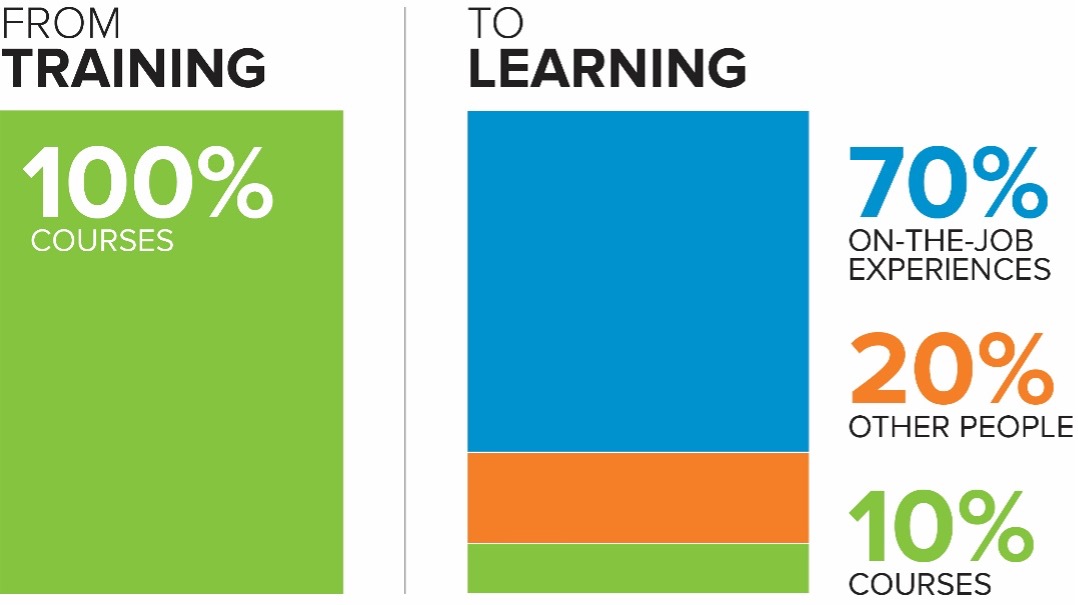
During my nearly 20 years in the world of learning and development, I’ve heard some variation of the phrase, “We need more training” more times than I can count. The problem with this approach is evident – more training means more time away from work, more resources, more money. And there’s no guarantee that sitting down for an online training course or traveling to an in-class workshop will help you improve your skills. Mentoring can be an excellent way to create meaningful, lasting, and timely learning opportunities that go far beyond those of traditional trainings. And it fits right in to the 70/20/10 approach to learning.

If you’re unfamiliar, the 70/20/10 model is a way to help visualize what learning can be when you think beyond traditional approaches to training (e.g., workshops, eLearning courses, etc.) According to this approach, 70% of what we learn comes from doing. Feedback from Argonne employees supports this; in our 2023 learning needs survey, 74.8% of the 522 respondents identified on-the-job experiences in their top 3 for learning opportunities. But in addition to learning by doing, it’s important for us to think about who can help us along that journey. That’s where engaging the right mentor fits in.

It’s easy to think of mentoring as limited to the 20% (relationships) of the 70/20/10 model. Truly impactful mentorship, however, can benefit your on-the-job experiences as well. When you cultivate a solid relationship with your mentor, you’ll often find a ready-made sounding board who can help guide you through your day-to-day work. Have you encountered a particular challenge? Talk to your mentor and ask them if they have ever experienced something similar. What did they do? What worked well? What didn’t work well? Have you recently taken a training course or program? Talk to your mentor about what you learned and how you think you might be able to use it. Having conversations like these not only broaden your perspectives and provide insight into the experiences of others, but it can provide you with actionable suggestions on how you can overcome barriers, address challenges, and lead yourself (and others) on a solid path forward.

Like so many things in life, you’ll get out of a mentoring relationship what you put into it. Whether you are a mentor or a mentee (and many times, they can be one and the same), remember this: mentorship is a great way to build a bridge between what we can learn in more formal settings and what we can do.


National Mentoring Month Mentoring Moment Series: The Importance of Getting Off to A Good Start with SMART Goals

To celebrate National Mentoring Month, we are featuring a series of guest posts reflecting on mentorship. This week features advice on setting SMART goals from George Vukotich, Organization Development Lead with the Argonne Leadership Institute.

It’s a new year, which means it is time for New Year’s resolutions. Just as it can be hard to follow through on New Year’s resolutions, it can be equally as hard to follow through on our mentoring commitments. This is where SMART Goals can help.

Often individuals realize they could benefit from having someone to bounce ideas off or ask for advice, but they are not sure where to start. Even if they have someone to talk to, they are not sure what to talk about.

Have you ever been to a meeting or met with someone where it felt like you were just meeting for its own sake with no purpose? Having mentoring meetings just to meet rarely leads to productive outcomes. While it is nice to say that you have met with your mentor or mentee, the purpose of having mentoring meetings is to create productive insights on how to move your ___________ (project, career, education, etc.) forward. Without goals, time just gets burned up. While goals may change, there needs to be a starting point and a destination to strive for. By knowing what you want to achieve and having a set time to achieve it in, both the mentor and the mentee can concentrate their efforts to get where they want to be and avoid the many distractions that come up along the way.

Here’s what SMART Goals are about:

Basically, I suggest that the mentee start the process and then share what they have written down with their mentor to come to an agreement on whether the goals are realistic and how to make it happen. This may be a repetitive process, but it is better to get agreement up front than to spend time hoping that that something productive will happen.
This said, the mentoring relationship should not have too many goals. I recommend 1 to 3 over a six-month period as being manageable and realistic. It is also important to put measures in place and review the goals that have been set. A monthly check-in to evaluate progress can help, and if adjustments need to be made, changes can be made accordingly.

Getting off to a good start is the key in having a successful mentoring relationship. Start the new year off right by setting some SMART goals.

Want to know more about developing mentoring goals and a plan of action? Check out the tools developed for the Argonne Mentoring Program (login required).