Meaningful Mentoring Workshop–Maintaining Effective Communication in Mentoring Relationships

The Postdoctoral Program Office will offer the last Meaningful Mentoring Workshop of the year on Tuesday, December 17th. This session will focus on ways to maintain effective communication in a mentoring relationship. The target audience includes postdoctoral appointees, mentors and supervisors. Case studies, group discussion and interactive exercises will be used to illustrate learning objectives. Materials presented will draw from the Center for the Improvement for Mentored Experiences in Research https://cimerproject.org/. While examples from a research setting will be presented, the concepts covered in this workshop can be applied to other mentoring experiences.

The workshop will run from 10:00 AM to 11:30 AM in Building 201, Room 102.

Please register through the RSVP link by December 13th.

Materials from the first two Meaningful Mentoring Workshops are available on Box.

Learning Objectives

At the end of this workshop, participants will be able to:

  • Provide constructive feedback to mentees
  • Identify different communication styles
  • Engage mentees/mentors through active listening
  • Identify challenges to providing feedback via email

Workshop Agenda:

  1. Introductions and warm up exercise
  2. Case study exercise–Your Presentation Needs Help
  3. Activity–assessing communication styles
  4. Overview of communication styles and strategies for active listening
  5. Case study exercise–The Feedback E-Mail
  6. Summary and relation to core values

Facilitator:

Kristene (Tina) Henne, PhD, is the Postdoctoral Program Lead at Argonne. In this role, she facilitates postdoc career development, mentoring, advises the Postdoctoral Society of Argonne and serves as a navigator for postdoctoral issues. She has presented JumpStart Seminars on Mentoring at Argonne and has facilitated mentoring workshops for organizations such as the National Postdoctoral Association and the Association for Women in Science, Chicago Chapter. Henne earned her Ph.D. in biological sciences from Purdue University and holds certificates in Mediation Skills Training from Northwestern University School of Professional Studies and the Center for Conflict Resolution in Chicago.
Meaningful Mentoring Workshop to Focus on Setting Expectations, Assessing Understanding

The Postdoctoral Program Office will offer the first Meaningful Mentoring Workshop of the year on January 31, 2019. This first session will focus on two fundamental skills in mentoring–setting expectations and assessing understanding. Future sessions to be scheduled will address maintaining communication, setting mentoring goals and basic steps in building a mentoring relationship.

The series is recommended for anyone seeking to strengthen skills as either a mentor or mentee and have more meaningful mentoring relationships. The target audience includes postdoctoral appointees, mentors and supervisors. Topics covered are applicable to non-research settings as well.

The workshop will run from 11:00 AM to 2:00 PM. Food will be provided. All are welcome to attend. Please register through the RSVP link by January 28th.

Learning Objectives

At the end of this workshop, participants will be able to:

  • Identify expectations for mentors and mentees
  • Understand the impact of misaligned expectations and making assumptions
  • Communicate expectations using tools such as mentoring compacts
  • Assess understanding through thoughtful questioning

Workshop Agenda:

  1. Introductions
  2. Overview of mentoring, mentor/mentee roles and phases of mentoring relationships
  3. Case study exercise–challenging assumptions
  4. Case study exercise–aligning expectations
  5. Overview of tools to set and assess expectations
  6. Case study exercise–mentor/mentee misunderstanding
  7. Overview of communication tools for assessing understanding
  8. Summary and relation to core values

Facilitator:

Kristene (Tina) Henne, PhD, is the Postdoctoral Program Lead at Argonne. In this role, she facilitates postdoc career development, mentoring, advises the Postdoctoral Society of Argonne and serves as a navigator for postdoctoral issues. She has presented JumpStart Seminars on Mentoring at Argonne and has facilitated mentoring workshops for organizations such as the National Postdoctoral Association and the Association for Women in Science, Chicago Chapter. Henne earned her Ph.D. in biological sciences from Purdue University and holds certificates in Mediation Skills Training from Northwestern University School of Professional Studies and the Center for Conflict Resolution in Chicago.

The Mentee Minute–Getting Specific Feedback

Recently, we talked about why it is important for mentors and supervisors to give specific feedback and ways to do that through the SBI model. SBI stands for Situation-Behavior-Impact and is a three-step model to give feedback that helps the mentee understand not only what they did (right or wrong), but also reinforces why it is important to learn from the experience and the impact of the behavior.

But what if you are on the other side of the desk–the mentee seeking feedback? Can you use this model in reverse to guide your mentor through understanding your needs? Are there other ways of asking for specific feedback? Yes!

Consider a situation where you are on the job hunt and are hitting some roadblocks during the interview phase. You schedule time with your mentor to talk about your challenges and ask for feedback. You mentor says something to the effect of, “You’re doing great! You just need to sell yourself better.” The conversation ends there.

Is there anything wrong with this scenario? Not necessarily. That’s common advice all postdocs get when they are on the job market. But what do you do with this information? Is there anything you can act on? Have any behaviors been identified that would be good “selling points”? Have you discussed any situations where you’ve demonstrated these selling points? Do you know how to articulate the impact, which leads to understanding your value?

Try asking for more. You could respond, “I know! I hear that a lot. Can we talk for a few moments about how I can do that more effectively? What do you consider to be my strengths? If you were me, what specific attributes would you point out if you were trying to sell yourself?”

If you ask an nebulous question (e.g. do you have any feedback for me?), you will likely get a nebulous answer. Be specific. Mentors cannot know what you need if you don’t ask.

Nebulous Specific
Do you have any feedback on my presentation today? I’ve been working to improve describing the impact of my results in my presentations, rather than just showing the data. Can we talk about how that went today and what I can do to improve?
How are my collaboration skills? I appreciate being given the latitude to lead interactions with other groups and I think it is important to learn how to collaborate effectively. Let’s talk about how I’m managing communication with  our collaborators and identify what is working and what I could do better.
How would you rate my time management? With multiple projects, it is important for me to manage my time effectively. I’d like your opinion on my current ability to manage my time and ideas for improvement. What methods have worked for you while managing multiple projects throughout your career?

Want more tips on getting specific feedback? Check out articles from the following sites to start.

The Ladders–How to ask for feedback that actually makes a difference

Harvard Business Review–How to Get the Feedback you Need

Forbes–Turn the Tables and Ask for Feedback

Forbes–40 Questions to Ask a Mentor


Mentoring Skills Tune-Up–Reality Testing

As a self-proclaimed mentee, I’ve fallen victim to the unrealistic view that mentors have all the answers. On the flip side, as a mentor, I’ve had to resist the urge to blurt out solutions and answers to my mentee’s issues. While expecting or providing quick answers may seem to be an efficient way to mentor, it hardly supports the notion of mentoring as the valuable component of learning that it is.

We’ve discussed on here previously that mentors are not meant to be “fixers” and sometimes may have to take a step back and help mentees learn from mistakes. This requires conversations that bring to light what’s on the mentee’s mind and asking questions to assess understanding.

Once you’ve had an honest and open conversation with your mentee and have some ideas to explore, what’s next? In the spirit of learning, now is a good time to help your mentee generate options and do a little reality testing. Here’s what that might look like.

Consider the case in the last blog post. The conversation ended like this:

As the conversation goes on, John keeps returning to this state of frustration. You begin to suspect there is a lack of understanding between John and his manager. Your reframing response might be something like: “It sounds like having clear expectations from your boss is important to you and that you would like more feedback. Let’s think of some ways of how you might communicate this to your boss…”

Already, the mentor has given John a cue that it is time to think of some options for solving his dilemma. What might those options be? For one, he may be thinking about how to let his boss know he needs clarity around expectations for his performance. In thinking how to approach this conversation, you may ask John to consider how his boss might respond depending on how he starts the conversation. This is a type of reality testing where you ask the mentee to put themselves in the other person’s shoes or see the situation from the other person’s point of view. In this scenario, “flipping” the roles may help John come up with several ways to start the conversation.

What if after all this discussion, John decides he wants to do nothing. You might be thinking, “Maybe he just needed to vent.” Keep in mind, though, that doing nothing is an option, and as such, it needs to be reality tested. In this case, you might respond, “Okay. That is one path you can take. Let’s talk for a moment about what that might look like.” And then you may wish to encourage John to think about the consequences by asking questions such as:

  • What do you think will happen if you doing nothing?
  • How might you expect things to change?
  • What kind of things can you do if the situation doesn’t change?

Generating options and testing them out is about pushing brainstorming past the idea phase and into the results phase. It is about asking the “what if” and “how” type of questions. What do you think will happen if you do X? What do you think the response will be if you say Y? What is the best/worst thing that can happen if you do nothing? How will doing X, Y or Z get you closer to your goals? How do you think doing X, Y or Z will impact your current situation? What would you like to see happen and how will the proposed solution get you there?

As you and your mentee work through reality testing options, don’t forget past lessons on asking open ended questions and clarifying understanding along the way. Conversations are a journey, not a destination!

Additional reading for having productive mentoring conversations:

Coaching Questions for Mangers Using the GROW Model

A Useful Guide to Mentoring by Pansophix Limited

Looking at questions from a Mentee’s point of view—Questions for Mentees to Ask Mentors

Zachary, Lois J. (2012).The Mentor’s Guide: Facilitating Effective Learning Relationships, 2nd edition. San Francisco, CA: John Wiley & Sons, Inc.

Where I learned reality testing as a practical concept:

Center for Conflict Resolution

Northwestern School of Professional Studies Mediation Skills Training Program

Mentoring Skills Tune-Up—Assessing Understanding

When I was a Postdoctoral Appointee I had the opportunity to mentor a summer student. My supervisor had cautioned that taking on a student could be a lot of work, but if I was up to it, she’d support me. Seeing it as an opportunity to build my own mentoring skills and add a spark of life to our lab, I accepted the challenge. My student mentee was eager to learn and asked a lot of questions that forced me to go back to the basics and make sure I understood fundamental concepts behind the techniques we used. In turn, I asked her a lot of questions to assess her understanding of what we were doing to make sure she got the “big picture” and was comfortable performing experiments. It was a fun and educational experience for both of us!

There are different techniques you can use to assess understanding of procedures and techniques. Being a visual learner, drawing diagrams is one of my favorites. When it comes to mentoring conversations that are not centered on a process or procedure though, assessing understanding can present unique challenges.

Recently, we explored how to plan mentoring conversations and the use of questions and curiosity to keep conversations going. But what happens if you sense that you and your mentee are no longer on the same wavelength? What can you do if you feel the conversation has drifted off track? How will you respond if your mentee expresses frustration that you are not understanding?

While not as straightforward as drawing diagrams—which could help, by the way—there are tools to assess and affirm understanding in conversations. Two such tools that are used in the mediation field are summarizing and reframing. These dovetail nicely with active listening and asking open-ended questions and can help get over hurdles that are impeding progress in your mentoring relationship.

Summarizing

Summarizing is different than simply repeating back what you heard. When you summarize, you are providing an abbreviated version of what your mentee articulated. It captures the salient points, so listen for key words and those points conveyed with greater emotion. When you summarize your mentee’s message, you provide a chance for clarification and affirm that you are listening. You can ask, “Did I get that right?” This is a good technique to reuse throughout your mentoring conversations to make sure you and your mentee are making progress towards your goals. Summarizing can lead to new questions and set up the next step in your mentoring journey.

Reframing

Reframing is a technique that can be used to assess and affirm understanding, acknowledge emotions and help move from a state of negativity towards one focused on moving forward. Reframing statements might begin with, “What I am hearing from you is…” or “It sounds to me like you…” This recognizes your role in building understanding and again, provides a chance for the mentee to make clarifications. Reframing is a way to take a complaint or negative position and state it in such a way that the goal now becomes one of problem solving.

For example, consider the following scenario, adapted from the Beyond Mentoring toolkit developed for the National Postdoctoral Association.

John, your mentee, has been having trouble understanding his manager’s expectations for his work deliverables. John is very talkative and sees himself as someone who can get along with anyone. He is having a hard time understanding why his manager “doesn’t like him.”  They have weekly meetings where he goes into great detail of all that he’s done, including things that worked and didn’t work.  His manager is not as talkative and doesn’t say much in the meetings. When she does, she gives John the impression that he’s not working on the right things or is on the wrong track. John starts off your mentor meeting telling you about the latest pitfalls. It is clear from his body language that he is frustrated. He is slouching, shaking his head and rolling his eyes at times. “No matter what I do, it never seems to be right!” he says. “We meet every week and it’s always something new. And to make it worse, I’m never quite sure what I’m doing wrong. I’m working hard and doing a lot, but getting nowhere with my boss. I just can’t seem to win.”

As the conversation goes on, John keeps returning to this state of frustration. You begin to suspect there is a lack of understanding between John and his manager. Your reframing response might be something like: “It sounds like having clear expectations from your boss is important to you and that you would like more feedback. Let’s think of some ways of how you might communicate this to your boss…”

In the reframed response, you captured the main issues (unclear expectations and feedback) and shifted the mindset from a cycle of frustration (“I can’t win”) to one of problem solving (“Let’s think of some ways…”). This puts your mentee in a position to learn and grow, while at the same time, communicates that you understand not only the issue, but also how he feels about it.

Assessing understanding is key to cultivating mentoring relationships. It is part of maintaining effective communication, which is a pillar of effective mentoring. For this and more on cultivating relationships, the University of Wisconsin Institute for Clinical Translational Research offers a good starting point for further reading. The information and linked resources are applicable to any mentoring scenario—not just research mentoring. Check it out!

Curiouser and Curiouser! Asking Questions to Keep the Conversation Going

“Curiouser and curiouser!” Cried Alice (she was so much surprised, that for the moment she quite forgot how to speak good English).”
― Lewis Carroll, Alice’s Adventures in Wonderland & Through the Looking-Glass

This past year, I had the pleasure of participating in a Facilitative Mediation Skills class at the Center for Conflict Resolution in Chicago. A mediator’s main jobs are to listen and to help two parties have a productive conversation. That’s it in a nutshell. We aren’t there to dictate answers or solutions, but to help other people, who seem to be at odds with one another, come to their own conclusions and agreement.

The reason this approach works is that when people define their own course of action, they are more likely to stick to it. The outcomes of the conversation are more achievable and sustainable when the two parties take ownership over them than if someone else just hands them the answers or tells them what to do.

I couldn’t help but see the parallels with mentoring.

As mentors, our job is not to have all the answers. We are there to help the mentee grow and develop. If we take it upon ourselves to be the “fixers”, we are not doing our mentees any favors. Instead, we need to listen and help our mentees think through issues and concerns and carve out their own paths.

How do we do this?

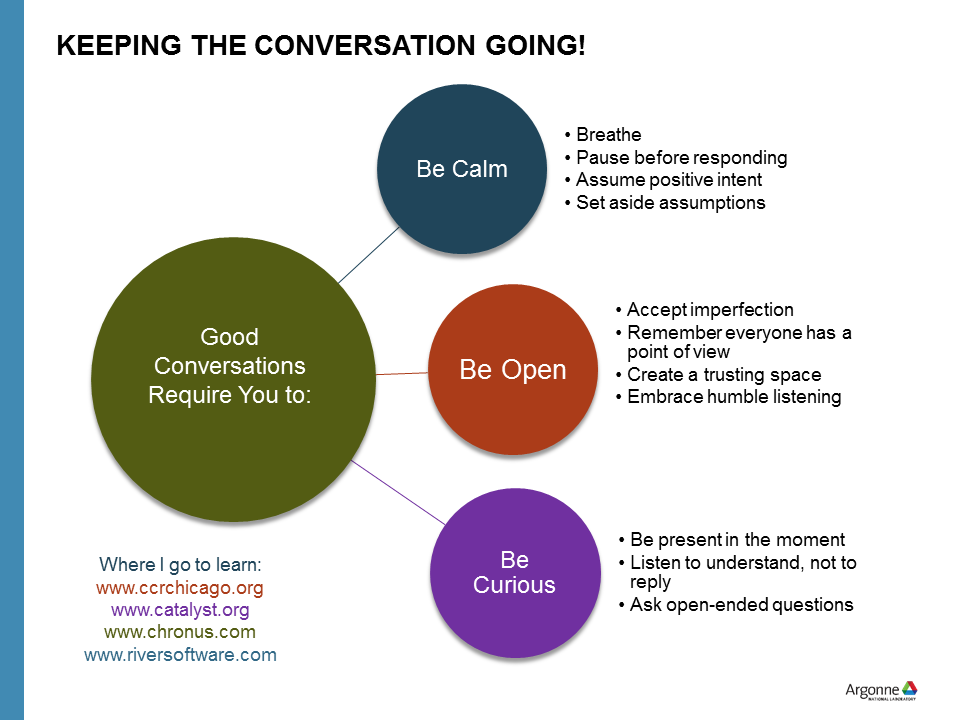
Fig. 1: Be calm, open and curious to have a good conversation.

Well, as one of the Mediation Skills coaches put it, we need to be calm, open and curious.

Being calm doesn’t mean that you anticipate a conversation will be confrontational. On the contrary, being calm allows you to clear your mind and consider what the other person is saying before you respond. A few things you can do to be calm before and during a conversation are to take a few slow, deep breaths, pause before responding and assume the other person is coming from a place of goodwill or positive intent.

Now that you are calm, you are in a position to be open. Open to what? Be open to other points of view, to making mistakes, to new ideas and questions that might come up. Be open to learning.

This takes us to the last point, which is to be curious.

Curiosity is a key skill in mentoring conversations. Curiosity probes us to want to know more. Where is the mentee coming from? How are they feeling? What is driving their issues and concerns?

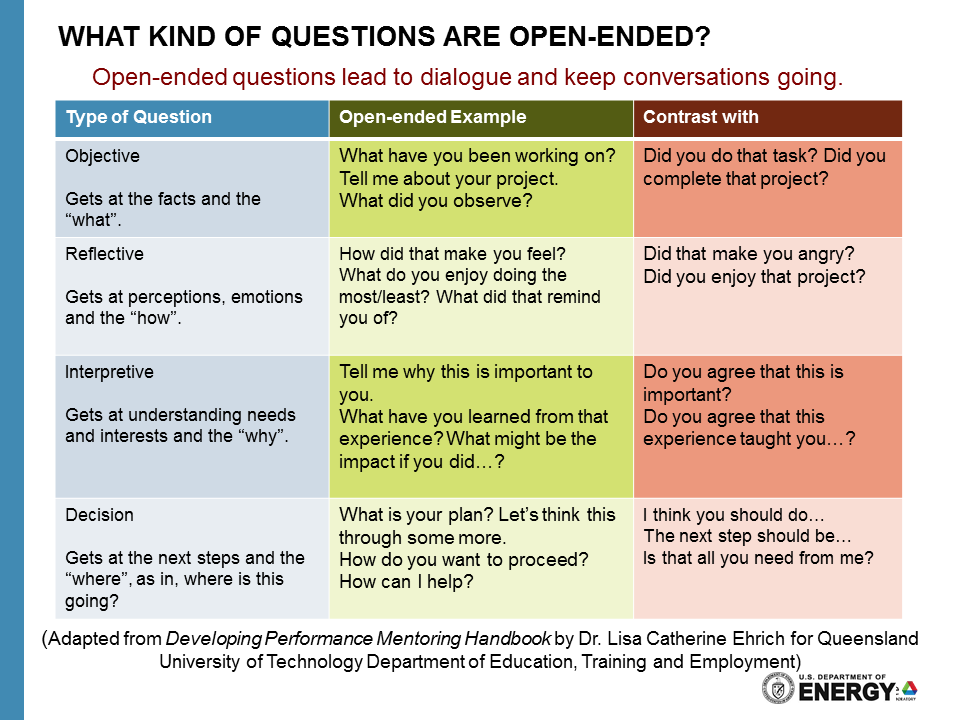
Curiosity is what allows us to ask open-ended questions. These are questions that invite more than just a yes or no answer. Open-ended questions keep the conversation going and can really get to the heart of the matter being discussed. Asking good questions is a powerful tool to foster learning.

What kind of questions should you consider asking? Well, what is it that makes you curious? What do you need to know more of? There are questions that get at the “what, why, how, where.” It all depends on what information is needed to get closer to understanding.

Examples of open-ended questions are shown in Figure 2. I also recommend two articles by Randy Emelo, Founder of River Software for mentoring solutions. These can be found on the River Software blog and at Chief Learning Officer.

Be calm. Be open. Be curious. And have yourselves some great conversations!

Figure 2: Open-ended questions invite more than yes or no answers.