Resiliency in the Workplace

To celebrate National Mentoring Month, we are featuring a series of guest posts reflecting on mentorship. This week’s feature from Shanissa Bell, Leadership Development Programs Lead with the Argonne Leadership Institute, writes about an important topic and one where mentors are critical–resiliency!

Do you sometimes struggle with adapting to the never-ending changes in your work environment? Are you looking for ways to balance frequent churn with your need to be productive or to achieve success? If you answer yes to either of these questions, you are not alone. According to the 2020 Workplace Resilience Study, “only 15% of workers worldwide exhibit high resilience” (ADP Research Institute, 2021). When we think about resilience in the workplace, we are really referring to an individual’s ability to fully adapt to challenges, change, and stressors. Being resilient in the workplace means that you have developed the skills to adjust and grow when you receive new and sometimes conflicting information or when dealing with changes in the organization or its structure.

In today’s world, employees are subjected to an immeasurable amount of pressure and uncertainty. Employees often deal with poor communication, lack of autonomy or support, and higher than average workloads. While it is important to understand what causes workplace stressors, it is equally important to recognize that your personal resiliency or your ability to ‘bounce back’ is a skill that can be improved.

Employees who are highly resilient have many characteristics in common that are worth exploring. Here are 4 examples of common traits in highly resilient people that can help you improve your own skills in these areas.

  1. Resilient employees have a positive outlook

Resilient employees not only have a positive outlook at work; they are also realistic about situations that are within their control and are aware of things that they are unable to change. These employees don’t fixate on uncertainty but instead look for opportunities to improve the situation.

How can you improve this skill? Concentrate on things that are in your control. You may need to shift your mindset from thinking about what you can’t do to what you are able to do. Try to remain positive and if you encounter a roadblock, bring other people in who can assist you in determining your next steps.

2. Resilient employees are flexible

Being able to pivot is necessary when dealing with change. Employees who are flexible tend to be open-minded and focus on their ability to switch between tasks quickly. This helps them adjust to fluctuations in their day-to-day tasks.

How can you improve this skill? As an employee you can develop your flexibility by taking on projects to learn new skills. You can also advocate learning from others on your team. You may even take on stretch assignments that allow you to work in areas that are not routine for your job. Doing these things will increase your skill base and allow you to take on new initiatives quickly.

3. Resilient employees have a sense of purpose

“Highly resilient people are 3.9 times more likely to love what they do” (ADP Research Institute, 2021). When an employee believes in the mission and the vision of the organization that they work for, they are more likely to want to see the organization succeed. This in turn increases the success of the employee.

How can you improve this skill? You can start by seeking to understand the goals of your organization. By understanding the mission and what the organization is working towards accomplishing, you can ensure that there is an alignment in your work and what you care about as an individual.

4. Resilient employees have strong social support

Employees who can work through challenging situations and succeed in the face of change have strong social networks. This is extremely important in the workplace. Resilient employees have peers, mentors, and leaders that they can confide in and ask for help when needed.

How can you improve this skill? Network, network, network! Expanding your social circle is a great way to deal with workplace stress and change.  You can build your network by attending both internal and external networking events, you can join an ERG or join a cross-functional project team. Taking these steps will help you build a network of supporters that can help you during challenging times.

Finally, while you may find it difficult to deal with uncertainty or ambiguity, there is a light at the end of the tunnel. Change is to be expected but you can increase your resiliency skills to help you adapt to future situations. Understanding what affects resiliency is the first step in creating a plan to productively decrease workplaces stressors while increasing your ability to succeed.


Sources:

ADP Research Institute. (2021, March 23). MIT Sloan Management Review: The Top 10 findings on Resilience and Engagement – ADP Research. ADP Research. https://www.adpresearch.com/assets/mit-sloan-management-review-the-top-10-findings-on-resilience-and-engagement/


 

Empathy in Action: The Crucial Role of Emotional Intelligence in Effective Mentorship

To celebrate National Mentoring Month, we are featuring a series of guest posts reflecting on mentorship. This week’s feature from Jeremy Boldt, Manager, Learning and Organization Development with the Argonne Leadership Institute, discusses the role of emotional intelligence in mentoring.

Reflecting on my career in learning and development, as well as my mentoring experiences, both as a mentee and mentor, I’ve realized the importance of people over process. With nearly two decades in organizational learning and development, I’ve noticed a preference for structured processes and metrics. However, influenced by my humanities background (and borrowing a term from one of my Argonne colleagues), I recognize the value of the “squishy” aspects of development—those unmeasured elements that hinge on emotional intelligence.

Emotional intelligence, a concept explored through various models, highlights how our emotions and personalities impact our experiences. The Emotional Intelligence 2.0 model by Dr. Travis Bradberry and Dr. Jean Graves outlines four key skills: self-awareness, self-management, social awareness, and relationship management. These skills are crucial in mentoring:

  • Self-Awareness: Understand your motivations and reactions. Before seeking your mentor’s perspective on a work issue, reflect on your drivers to frame the conversation effectively.
  • Self-Management: Use self-awareness to manage your reactions. If something bothers you, prepare mentally before discussing it with your mentor, fostering a more productive dialogue.
  • Social Awareness: Focus outward to appreciate others. In mentoring, strive to understand and value your partner, enhancing the relationship and mutual learning.
  • Relationship Management: View mentoring as a long-term relationship. Building and maintaining a strong connection requires effort, with both parties responsible for deepening the bond.

Consider these skills as part of a continuous journey: know yourself, manage yourself, understand others, and maintain connections. Mentoring will have its challenges, but embracing discomfort and seeking honest feedback can strengthen trust and foster a robust mentoring relationship.


Leaders in Mentoring: When to Lead and When to Learn

To celebrate National Mentoring Month, we are featuring a series of guest posts reflecting on mentorship. This week’s feature from Shanissa Bell, Leadership Development Lead with the Argonne Leadership Institute, highlights how mentorship help us as leaders AND learners!

Leaders in organizations are often encouraged to become mentors for employees who are interested in topics such as honing technical skills, navigating advancement opportunities, and increasing their network reach and influence. Mentoring is a way for leaders to give back by sharing the knowledge that they have gained over the course of their career. Having the opportunity to participate in a mentoring relationship helps facilitate a mentee driven understanding of where you are versus where you want to be.

When most people think about leaders in mentoring, they automatically assume that the leader is cast in the role of the mentor. While this is true in many mentoring relationships, it is easy to overlook that leaders can benefit from having a mentor of their own. As a leader, it is important to think about both the development of others and your self-development needs. Whether or not you are the mentor, or the mentee is dependent upon where you are in your own development. When considering a mentorship role, ask yourself, is it time for me to lead or time for me to learn?

The Leader as a Mentor
Do you have advanced technical knowledge, or have you moved up through the organizational ranks to reach your current position? Do you have the time and energy to provide a beneficial relationship to a mentee? These are a few of the questions you can ask yourself to help determine if the role of a mentor is right for you.  Mentors are adept at giving back by sharing their individual journey and skills with others.  This transfer of knowledge is invaluable in helping employees explore their skills and future career paths in a one-one-one personalized setting. Mentors in this capacity must be willing and able to provide structured feedback based on personal experience and mentors should be committed to being available to their mentees as an advisor and sounding board. Becoming a mentor will allow you to help others expand their careers.

The Leader as a Mentee
It is often the case that development opportunities for leaders decrease as your position or level increases. Sometimes we expect leaders to know everything that there is to know once they are promoted or hired into a leadership role. However, many leaders will say that they wished they had the opportunity to receive a mentorship as a way of acclimating to their role and responsibilities. If you are a leader who feels like there are skills that you want to improve or if you would like to learn more about your current organization and its culture, the mentee role may be the right path for you. Experiencing personalized development as a mentee can also help you prepare for a role as a mentor to others.

Reciprocity in Mentoring
One major benefit of a mentoring relationship is reciprocity. Reciprocity can be defined as the practice of exchanging things with others for mutual benefit. Mentoring provides a give and take relationship and validates your leadership capabilities. As a mentor you can share your knowledge with someone else while improving your own communication, empathy, and listening skills.

Mentees also benefit greatly from the mentorship relationship. Their skills are strengthened by receiving direct feedback and career guidance. At the same time, they also provide new perspectives to the mentor and help strengthen the mentor’s ability to provide guidance to another individual.

What Role is Right for Me?
As a leader, you have a unique opportunity to provide mentoring and receive mentoring. The role you choose should be closely tied to where you are in your own development journey. Do you feel like you have valuable information to share with others or do you feel like you need a little more practice to strengthen your own skills? There is no right, or wrong answer. You may even have the bandwidth to be both a mentor and a mentee.  A cornerstone to mentoring is allowing yourself the time and space to serve in the role or roles that you choose. Remember, the final decision is up to you.


The Power of Connection: Prioritizing Relationship Building in Professional Mentorships

To celebrate National Mentoring Month, we are featuring a series of guest posts reflecting on mentorship. This week’s feature from Katherine Murphy, Employee Development Lead with the Argonne Leadership Institute, emphasizes the importance of building a strong relationship with your mentor or mentee.

Mentorship is an exceptional employee development tool available for those who want to positively impact their professional growth. One crucial component of a successful mentorship experience is the level of relationship built between the mentor and mentee. Focusing on building a strong relationship with your mentor or mentee early on, and being intentional about maintaining that focus, not only helps to go beyond the basic exchange of information during your interactions. It helps create depth in your mentorship experience, allowing true learning and growth to occur.

Why Prioritize Relationship Building in Mentorship?

  1. Comfort. The better you know your mentor and mentee, the more you will be willing to share with them. Your interactions will become less transactional or uncomfortable, and you will be more inclined to reveal details about your experiences, goals, etc. than you might to someone with whom you do not have a positive rapport.
  2. Trust. Similar to comfort, having mutual trust in a mentorship relationship allows you to be vulnerable and focus on areas that may be more impactful to your professional growth than those that are more surface level.
  3. A Personalized Approach to Mentorship. The more you know about your mentor or mentee’s goals, strengths, weaknesses, etc., the more tailored the guidance and support you can give and will receive.

Tips For Focusing on Relationship Building in Mentorship

  1. Set Clear Expectations. Be upfront about what you are hoping to gain from the relationship, as well as what you are able to give. An imbalance of expectations can create frustration and erode trust in a mentorship relationship, so it is imperative to set realistic expectations at the start.
  2. Be Honest and Follow Through. One way to build trust in your relationship is to be honest with each other. For example, if your mentor or mentee comes to you with an issue in which you do not feel you have the level of expertise needed to help, acknowledge that feeling instead of providing incorrect guidance. Work with them to brainstorm how they could find an expert in this area to help. Similarly, if you commit to something with your mentor or mentee, be intentional about honoring that commitment. If you are unable to follow through with it, show humility during your conversation with them about why you could not bring it to an end, being open and honest about the situation. Showing vulnerability and honesty helps create a safe space for the other person to also be vulnerable while building trust.
  3. Share Your Experiences. One powerful learning tool is storytelling. Sharing your experiences and how you have handled different situations (right or wrong) will help foster learning and open the potential for more meaningful conversations.
  4. Ask Questions and Practice Active Listening. Learn about your mentor or mentee by asking questions. For example, what are some effective ways we can create an environment of trust and mutual respect? Then, be intentional about actively listening to their responses. Demonstrate real interest in hearing about their thoughts and goals without becoming distracted. Ask about their hobbies or interests outside of the mentorship program and find commonalities.
  5. Bring Levity into the Mentorship Relationship. Adding lightness and appropriate humor to your mentorship can help create a more comfortable environment and improve rapport. This can include celebrating milestones, sharing a relevant meme, making a joke to lighten the conversation, or sharing lighthearted stories about your experiences. Be mindful of boundaries and context to reap the most benefit.

Participation in the Argonne Mentorship Program is a noteworthy step in taking ownership over your professional development and helping others excel. To experience the highest level of success and impact, be intentional about building and maintaining a strong relationship with your mentor and mentee. If building a relationship has yet to be a focus in your mentorship, it is never too late to start! Oftentimes these relationships expand beyond the program, realizing benefits to both people for years to come.

A Bridge to Learning: Mentorship and the 70/20/10 Approach

To celebrate National Mentoring Month, we are featuring a series of guest posts reflecting on mentorship. This week’s feature from Jeremy Boldt, Manager, Learning and Organization Development with the Argonne Leadership Institute, is about how mentoring supports learning and development goals.

In 2022, LinkedIn Learning published their report on the state of workplace learning. According to the report, “Opportunities to learn and develop new skills” was among the top five factors in employee career decisions. But what does this mean from a practical perspective? Learning and developing new skills are laudable goals, but in a sometimes frantic, change-heavy world, how can we as employees make this happen?

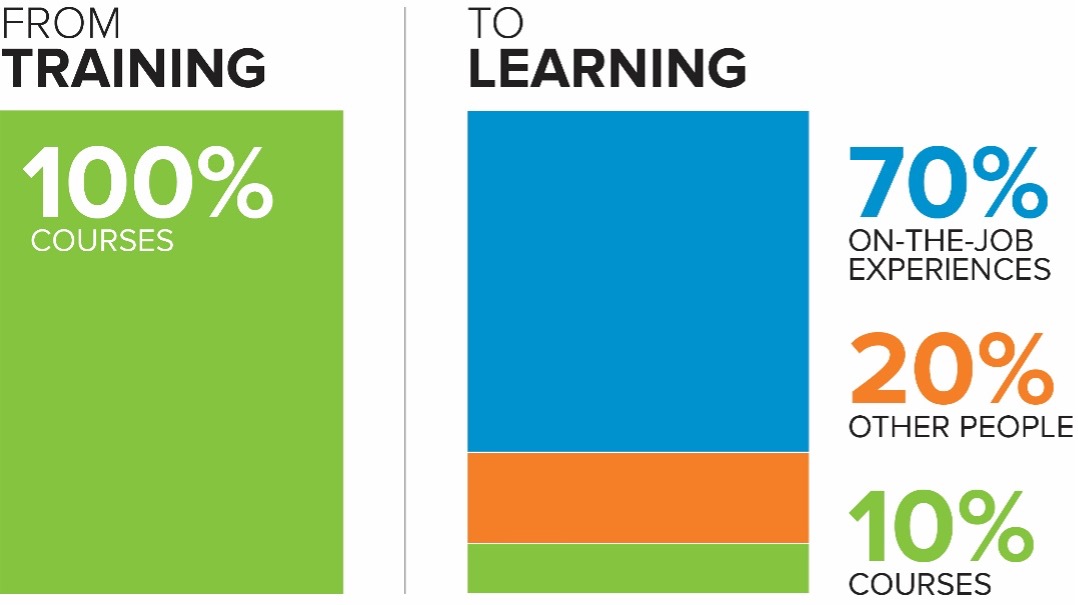
During my nearly 20 years in the world of learning and development, I’ve heard some variation of the phrase, “We need more training” more times than I can count. The problem with this approach is evident – more training means more time away from work, more resources, more money. And there’s no guarantee that sitting down for an online training course or traveling to an in-class workshop will help you improve your skills. Mentoring can be an excellent way to create meaningful, lasting, and timely learning opportunities that go far beyond those of traditional trainings. And it fits right in to the 70/20/10 approach to learning.

If you’re unfamiliar, the 70/20/10 model is a way to help visualize what learning can be when you think beyond traditional approaches to training (e.g., workshops, eLearning courses, etc.) According to this approach, 70% of what we learn comes from doing. Feedback from Argonne employees supports this; in our 2023 learning needs survey, 74.8% of the 522 respondents identified on-the-job experiences in their top 3 for learning opportunities. But in addition to learning by doing, it’s important for us to think about who can help us along that journey. That’s where engaging the right mentor fits in.

It’s easy to think of mentoring as limited to the 20% (relationships) of the 70/20/10 model. Truly impactful mentorship, however, can benefit your on-the-job experiences as well. When you cultivate a solid relationship with your mentor, you’ll often find a ready-made sounding board who can help guide you through your day-to-day work. Have you encountered a particular challenge? Talk to your mentor and ask them if they have ever experienced something similar. What did they do? What worked well? What didn’t work well? Have you recently taken a training course or program? Talk to your mentor about what you learned and how you think you might be able to use it. Having conversations like these not only broaden your perspectives and provide insight into the experiences of others, but it can provide you with actionable suggestions on how you can overcome barriers, address challenges, and lead yourself (and others) on a solid path forward.

Like so many things in life, you’ll get out of a mentoring relationship what you put into it. Whether you are a mentor or a mentee (and many times, they can be one and the same), remember this: mentorship is a great way to build a bridge between what we can learn in more formal settings and what we can do.


National Mentoring Month Mentoring Moment Series: The Importance of Getting Off to A Good Start with SMART Goals

To celebrate National Mentoring Month, we are featuring a series of guest posts reflecting on mentorship. This week features advice on setting SMART goals from George Vukotich, Organization Development Lead with the Argonne Leadership Institute.

It’s a new year, which means it is time for New Year’s resolutions. Just as it can be hard to follow through on New Year’s resolutions, it can be equally as hard to follow through on our mentoring commitments. This is where SMART Goals can help.

Often individuals realize they could benefit from having someone to bounce ideas off or ask for advice, but they are not sure where to start. Even if they have someone to talk to, they are not sure what to talk about.

Have you ever been to a meeting or met with someone where it felt like you were just meeting for its own sake with no purpose? Having mentoring meetings just to meet rarely leads to productive outcomes. While it is nice to say that you have met with your mentor or mentee, the purpose of having mentoring meetings is to create productive insights on how to move your ___________ (project, career, education, etc.) forward. Without goals, time just gets burned up. While goals may change, there needs to be a starting point and a destination to strive for. By knowing what you want to achieve and having a set time to achieve it in, both the mentor and the mentee can concentrate their efforts to get where they want to be and avoid the many distractions that come up along the way.

Here’s what SMART Goals are about:

Basically, I suggest that the mentee start the process and then share what they have written down with their mentor to come to an agreement on whether the goals are realistic and how to make it happen. This may be a repetitive process, but it is better to get agreement up front than to spend time hoping that that something productive will happen.
This said, the mentoring relationship should not have too many goals. I recommend 1 to 3 over a six-month period as being manageable and realistic. It is also important to put measures in place and review the goals that have been set. A monthly check-in to evaluate progress can help, and if adjustments need to be made, changes can be made accordingly.

Getting off to a good start is the key in having a successful mentoring relationship. Start the new year off right by setting some SMART goals.

Want to know more about developing mentoring goals and a plan of action? Check out the tools developed for the Argonne Mentoring Program (login required).

Meaningful Mentoring Workshop–Maintaining Effective Communication in Mentoring Relationships

The Postdoctoral Program Office will offer the last Meaningful Mentoring Workshop of the year on Tuesday, December 17th. This session will focus on ways to maintain effective communication in a mentoring relationship. The target audience includes postdoctoral appointees, mentors and supervisors. Case studies, group discussion and interactive exercises will be used to illustrate learning objectives. Materials presented will draw from the Center for the Improvement for Mentored Experiences in Research https://cimerproject.org/. While examples from a research setting will be presented, the concepts covered in this workshop can be applied to other mentoring experiences.

The workshop will run from 10:00 AM to 11:30 AM in Building 201, Room 102.

Please register through the RSVP link by December 13th.

Materials from the first two Meaningful Mentoring Workshops are available on Box.

Learning Objectives

At the end of this workshop, participants will be able to:

  • Provide constructive feedback to mentees
  • Identify different communication styles
  • Engage mentees/mentors through active listening
  • Identify challenges to providing feedback via email

Workshop Agenda:

  1. Introductions and warm up exercise
  2. Case study exercise–Your Presentation Needs Help
  3. Activity–assessing communication styles
  4. Overview of communication styles and strategies for active listening
  5. Case study exercise–The Feedback E-Mail
  6. Summary and relation to core values

Facilitator:

Kristene (Tina) Henne, PhD, is the Postdoctoral Program Lead at Argonne. In this role, she facilitates postdoc career development, mentoring, advises the Postdoctoral Society of Argonne and serves as a navigator for postdoctoral issues. She has presented JumpStart Seminars on Mentoring at Argonne and has facilitated mentoring workshops for organizations such as the National Postdoctoral Association and the Association for Women in Science, Chicago Chapter. Henne earned her Ph.D. in biological sciences from Purdue University and holds certificates in Mediation Skills Training from Northwestern University School of Professional Studies and the Center for Conflict Resolution in Chicago.

Thank Your Mentor Day to Close Out National Mentoring Month

Each January, during National Mentoring Month, we are presented a chance to reflect on mentoring—what it means to be a mentor and how mentors have helped us learn and grow. I’ve shared my own experiences as both a mentor and mentee on here before. As a mentor, I’ve been fortunate to have had the chance to help others acclimate to a new environment and find their way through their own career path. I didn’t know I was viewed as a mentor until each “mentee” wrote to me years later to thank me for being a mentor to them.

The sense of purpose each of these random notes brought is the type of benefit mentors commonly report as why they choose to mentor others. If you note from my examples, you might not have “mentor” as an official title, but bear in mind, someone may see you in this light.

As a mentee, I’ve benefited in uncountable ways from mentors—official and unofficial. Whether it was getting a boost of confidence, being introduced to new professional opportunities, or being challenged when I needed it the most, mentors have helped me learn and grow as an individual and professional.

I continue to reach out to my mentor network as I journey through my career. When I transitioned from being a Postdoctoral Appointee to the Postdoctoral Program Coordinator almost eight years ago, there was a steep learning curve. My Division Director at the time thought it would be useful to connect with mentors who had taken similar career paths. That’s when I met Katie Carrado-Gregar, Associate Division Director for CNM User Programs & Operations. Katie helped me gain a broad view of the Laboratory and learn how to communicate with people across the career and leadership spectrum. I also learned how to find value in my work and manage the “identity crisis” one goes through when moving from a research to a management role. While we have not established formal mentoring meetings, I still call on her from time to time for advice and guidance.

On January 31st, National Mentoring Month will come to a close with Thank Your Mentor Day and I encourage everyone to reflect on their mentoring experiences and thank their mentors. One way to do this is to give them a shout out on social media (LinkedIn, Twitter, Facebook, etc.) using the hashtag #ThankYourMentor.

This could be a photo with you and your mentor holding a #ThankYourMentor sign. Justin Breaux, Argonne’s Digital Social Media Producer with the Communications and Public Affairs organization, has offered to take photos and help get them promoted. If you are interested, talk to your mentor and let us know when Justin can come by and snap a photo.

Here are a few other ideas to thank your mentor:

  • Send your mentor a nice, handwritten thank you note
  • Offer your mentor a cup of coffee and share what you’ve learned from them
  • Write a recommendation for your mentor on LinkedIn
  • Stop by their office and just say, “Thanks!”
  • Pay it forward by mentoring someone else

There are so many small gestures that mean a lot in letting someone know you value their mentorship. Choose one and let everyone know what a great mentor you have!

Lastly, there will be Meaningful Mentoring Workshop focused on setting expectations and assessing understanding on January 31st. See details and registration information on Argonne Today.

It’s National Mentoring Month! What Is Your Memorable Mentoring Moment?

In the middle of grad school, I had a particularly bad thesis committee meeting. I had hit a plateau with my progress in both my research and professional growth and it showed…badly.

My committee hammered away, question after question, for which no answer seemed satisfactory. I wanted to shrink into invisibility. My graduate advisor watched the whole episode in silence.

I went home and cried, thinking this was the end. There was no way they’d let me finish my degree now. I wondered how they could do this to me? After how hard I had worked up to that point? How could my advisor let this happen to me? How could he let me fail like that?

Going back to school and facing my advisor was one of the hardest things I had to do as a graduate student. He must want me to quit, I thought. He’s trying to get me to quit. As we talked, though, I realized he wanted just the opposite. He wanted me to be successful. He wanted me to finish. But, he wanted me to “own” my work. Admittedly, I had not taken full ownership of my success yet.

Falling down like that was just the kickstart I needed to see my degree to completion. And as hard as it was for me to fail, it was just as hard for my advisor to let me fail. Luckily for me, he was invested enough in my success to help me get back up.

Secretary Perry talked about falling and failing in his visit this past week. When asked for advice to early career professionals, he told us to not be afraid to get out of our comfort zones, that it is okay to fall down and fail and that sometimes, we need people to help us get back up. And that is what mentors do.

Mentors are not there to be our “fixers.” They are there to help us grow–professionally and personally. Sometimes that growth involves learning from failure. Gifted mentors know when to step back and when to ask what we’ve learned from these occasions. They know how to let us come to our own conclusions. Mentors can offer us a hand up, but it is up to us to keep standing and move on.

I don’t recall ever thanking my graduate advisor–my mentor–for helping me get over that hump. Maybe I should. Now would be a good time to do that, as January is National Mentoring Month.

This is the perfect time to reconnect with your mentor. Ask them to coffee–and buy! Drop them a few lines to let them know what they’ve meant to you. Send them a hand-written note. Reverse the role and ask them what help you can offer. Whatever you do, take some time to honor mentors this month.

Join us on January 24th as we honor the 2017 Outstanding Mentor and Supervisor Award recipients. It’ll be a nice celebration of mentoring at the Lab. And hey, why not bring your mentor with you?