I’d Meet With My Mentor, But I Don’t Know What to Talk About

Recently, we discussed the value in asking questions to keep a conversation going. What happens when you don’t know where to start?

One common answer I’ve heard when I ask mentees if they’ve met with their mentors is, “I would, but I don’t know what to talk about.” Well, that surely can make keeping a conversation going quite a challenge.

When pressed, though, mentees will disclose a variety of topics they’d like to learn about, skills they’d like to develop or areas in which they’d like to improve. You can almost hear the “click” when they realize they can use these as discussion topics with their mentor. Someone just has to ask that question, “What do you want?” That someone can be a mentor, a peer or preferably, oneself.

Answering this question is one of the first–and vital–steps in launching a mentoring relationship. That’s not to say that it is an easy question to answer, though. I have a tough enough time answering that question when it’s time to plan dinner, let alone thinking about what I want from my career and how a mentor could help! Luckily, there is a wealth of resources out there to help you get started in setting your mentoring goals. While many of these were devised for postdocs and early career researchers, the concepts apply to any field. A few quick steps can help any mentee get started down their mentoring journey.

Think about where you’d like to go and what can help get you there.

Sound trite? It is. But that’s about as basic as it gets. You must know this about yourself before you can reap the benefits of mentoring. For postdocs, this might be an easy question to answer, as they have a definite need to get to some next stage of their careers. Mentees at other career levels might have to ponder this a little more. But, what if you don’t want to “go” anywhere? That’s okay. Maybe there are things you’d like to work on to grow professionally and personally in your current role.

Common topics mentees seek to work on with their mentors often include communication skills, leadership skills, networking, work/life balance, learning organizational culture and management skills. Researchers may prioritize discipline-specific skills that will help them become independent–proposal writing, lab management, publishing, collaboration. Whatever comes to mind, write it down.

Do a self-check to see what your current comfort level is with each topic.

How confident are you with your communication skills? Does writing grant proposals or publications scare you under the table? How much do you know about managing budgets or directing the work of others?

Some tools to help you gauge your level of confidence include:

While the last three were developed for researchers, they cover global transferable skills such as management, communication, leadership, networking, and managing conflict.

Write questions to ask your mentor about each topic and script your next meeting.

Let’s say, for instance, you’ve been told you have leadership potential and want to build on this. You’ve been reading books and articles on leadership and have been following several influencers on LinkedIn. When you sit down to write out goals for building leadership skills, you become overwhelmed and don’t know where to start. You feel confident in some areas, but less so in others. You might want to start your next mentoring conversation by saying something like, “I’d like to work on leadership development. This seems like such a broad topic, though. Can we spend some time discussing key leadership skills and identify some attainable goals I can work towards?”

Or, maybe you want to be more effective at networking. After your self-assessment, you seem pretty confident with your ability hold technical conversations with colleagues in your field. You are aware that your field is becoming more interdisciplinary and want to adapt and grow in this direction. Talking to people in other fields is a mystery to you, though. You might consider starting your next mentoring conversation by asking your mentor to talk about his or her journey and how they’ve met people and built relationships throughout their career.

Bring it all together by planning your mentoring meeting.
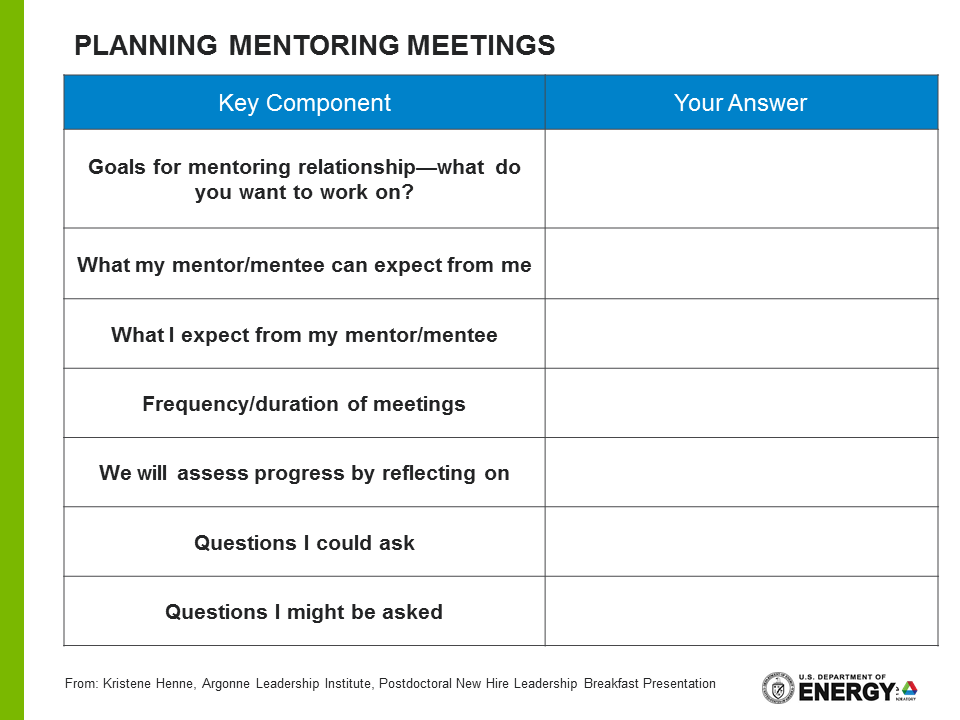
Quick guide for planning mentoring meetings. Click on image for link to table in PowerPoint.

Take this information–your goals, assessment, potential starter questions–and plan your next mentor meeting. And don’t just plan, schedule the meeting and go!

A little bit of planning can go a long way in achieving your mentoring goals. As you can see, questions are just as important in starting the conversation as they are in continuing the conversation!

Additional Resources:

National Association of Colleges and Employers guide for mentees (includes starter questions for a host of topics)

Tip Sheets for Mentors and Mentees

Questions to Ask and Points to Ponder for Mentors and Mentees

What’s a Mentor/ee to Do?

Energy and Global Security Directorate Celebrates the Completion of the First Year of the Support Administrative Staff Mentoring Program

On February 5th, participants of the Energy and Global Security Directorate (EGS) Support Administrative (SA) Staff Mentoring Program gathered to reflect on their first year of growth and learning and to plan for the next year’s activities and goals. Keith Bradley, Director, National Security Programs and recipient of the 2014 Outstanding Staff Mentor Award, opened the session with welcoming remarks on the importance of mentoring and key elements in building a mentoring relationship.

Bradley shared with the group that everyone benefits from having a mentor and that, “Building trust between the mentor and mentee is critical for success. And I personally think the best mentors are the ones who are not in the mentee’s management chain. The mentor must understand the mentee’s job responsibilities and the overall work environment. But the mentee must feel comfortable asking candid questions and seeking advice without fear of being critically judged. Trust and confidentiality are key to maximizing the benefits of the mentor-mentee relationship.”

Keith Bradley delivers welcome remarks at the EGS-SA Mentoring Program celebration.

EGS Support Administrator Supervisor, Wendy Torres provided an overview of how the EGS-SA Mentoring Program was formed. In November 2017, the Energy & Global Security (EGS) Diversity & Inclusion (D&I) Council introduced a Mentor Program for support administrative staff in the directorate in response to overall concern from EGS employees regarding lack of professional development opportunities. This concern, identified through the ‘What’s Next Diversity & Inclusion Climate Survey,’ was on the Council’s proposed list of action items for 2017. While it was agreed that a Mentoring Program would be valuable for all EGS employees, it was thought that the support administrative staff could serve as a pilot program. A discussion, facilitated by Postdoctoral Program Lead Tina Henne and EGS D&I Council Chair Molly Finster, with the EGS support administrative staff, successfully confirmed the need for and interest in a mentoring program.

As a follow-up to the facilitated discussion, the D&I Council mentor subcommittee surveyed the EGS support administrative staff on topics of interest, areas of expertise, and desired program type (i.e. mentor-mentee, group, or both). Based on their individual feedback, Torres, facilitated 13 mentor-mentee pairings and identified many topics for group mentorship events (such as procurement, travel, honorariums, BOX, etc.). In November 2017, a formal kick-off of the program served as the perfect opportunity to make introductions and to review the guidance document prepared by the D&I Council subcommittee, which provided useful tips and tools for mentor-mentee pairings. Throughout the year, the turnout at group mentorship brown bag events was an obvious indicator of success, averaging 22 attendees per event!

Following Torres’ recap of the program, IAEA Training Coordinator and EGS D&I Mentor Subcommittee Member, Natalie Zender, provided a summary of feedback from the Mentoring Program participants based on a survey that was sent by the EGS D&I Council at 6 months to check-in. Nearly 50% of respondents attributed the program to improving their skillset and other positive feedback included feelings of empowerment and benefits of networking. Still, opportunities for improvement are evident and mainly reside with the mentor-mentee pairings, which for almost a quarter of respondents are no longer active.

Susan Podoba (left) and Wendy Torres (right) lead a group activity at the EGS-SA Mentoring Program Celebration.

To close the event, Mentor Subcommittee Members, EGS Directorate Executive Assistant, Susan Podoba, and AMD Division Executive Assistant, Sharon Nykolyshyn, led an exercise where participants shared their ideas for future group mentoring sessions, brown bag training and professional development topics and renewed interest in being a mentor, mentee or both.

More than providing an avenue for staff to find a mentor, the EGS-SA Mentoring Program is helping to build a culture of mentorship, which goes hand in hand with modeling Argonne’s Core Values: Impact, Safety, Respect, Integrity, and Teamwork. Mentoring is a professional relationship that promotes talent development and trust by bringing employees together to share knowledge, skills, and experiences. We can all benefit from wider access to opportunities which aids to professional and personal goals to build a more capable, satisfied, and committed team.

About the Mentoring Program, Zender said, “It’s been a rewarding experience to be part of the creation of this mentor program – this mentor culture, really. The act of collaborating with the subcommittee on the development of this alone was a great opportunity for me to participate in a sort of group mentorship as I learned so much from their experiences and feedback. And, I hope to continue to use mentorship as a tool for the rest of my career.”

Creating a culture of mentorship is a continuous journey of listening, learning, and practicing. Sharing her own perspective as a mentor, Wendy Torres notes, “Mentoring is one of the best gifts you can give someone else. It helps to bring the best out of somebody else’s talents.”

It’s National Mentoring Month! What Is Your Memorable Mentoring Moment?

In the middle of grad school, I had a particularly bad thesis committee meeting. I had hit a plateau with my progress in both my research and professional growth and it showed…badly.

My committee hammered away, question after question, for which no answer seemed satisfactory. I wanted to shrink into invisibility. My graduate advisor watched the whole episode in silence.

I went home and cried, thinking this was the end. There was no way they’d let me finish my degree now. I wondered how they could do this to me? After how hard I had worked up to that point? How could my advisor let this happen to me? How could he let me fail like that?

Going back to school and facing my advisor was one of the hardest things I had to do as a graduate student. He must want me to quit, I thought. He’s trying to get me to quit. As we talked, though, I realized he wanted just the opposite. He wanted me to be successful. He wanted me to finish. But, he wanted me to “own” my work. Admittedly, I had not taken full ownership of my success yet.

Falling down like that was just the kickstart I needed to see my degree to completion. And as hard as it was for me to fail, it was just as hard for my advisor to let me fail. Luckily for me, he was invested enough in my success to help me get back up.

Secretary Perry talked about falling and failing in his visit this past week. When asked for advice to early career professionals, he told us to not be afraid to get out of our comfort zones, that it is okay to fall down and fail and that sometimes, we need people to help us get back up. And that is what mentors do.

Mentors are not there to be our “fixers.” They are there to help us grow–professionally and personally. Sometimes that growth involves learning from failure. Gifted mentors know when to step back and when to ask what we’ve learned from these occasions. They know how to let us come to our own conclusions. Mentors can offer us a hand up, but it is up to us to keep standing and move on.

I don’t recall ever thanking my graduate advisor–my mentor–for helping me get over that hump. Maybe I should. Now would be a good time to do that, as January is National Mentoring Month.

This is the perfect time to reconnect with your mentor. Ask them to coffee–and buy! Drop them a few lines to let them know what they’ve meant to you. Send them a hand-written note. Reverse the role and ask them what help you can offer. Whatever you do, take some time to honor mentors this month.

Join us on January 24th as we honor the 2017 Outstanding Mentor and Supervisor Award recipients. It’ll be a nice celebration of mentoring at the Lab. And hey, why not bring your mentor with you?

Curiouser and Curiouser! Asking Questions to Keep the Conversation Going

“Curiouser and curiouser!” Cried Alice (she was so much surprised, that for the moment she quite forgot how to speak good English).”
― Lewis Carroll, Alice’s Adventures in Wonderland & Through the Looking-Glass

This past year, I had the pleasure of participating in a Facilitative Mediation Skills class at the Center for Conflict Resolution in Chicago. A mediator’s main jobs are to listen and to help two parties have a productive conversation. That’s it in a nutshell. We aren’t there to dictate answers or solutions, but to help other people, who seem to be at odds with one another, come to their own conclusions and agreement.

The reason this approach works is that when people define their own course of action, they are more likely to stick to it. The outcomes of the conversation are more achievable and sustainable when the two parties take ownership over them than if someone else just hands them the answers or tells them what to do.

I couldn’t help but see the parallels with mentoring.

As mentors, our job is not to have all the answers. We are there to help the mentee grow and develop. If we take it upon ourselves to be the “fixers”, we are not doing our mentees any favors. Instead, we need to listen and help our mentees think through issues and concerns and carve out their own paths.

How do we do this?

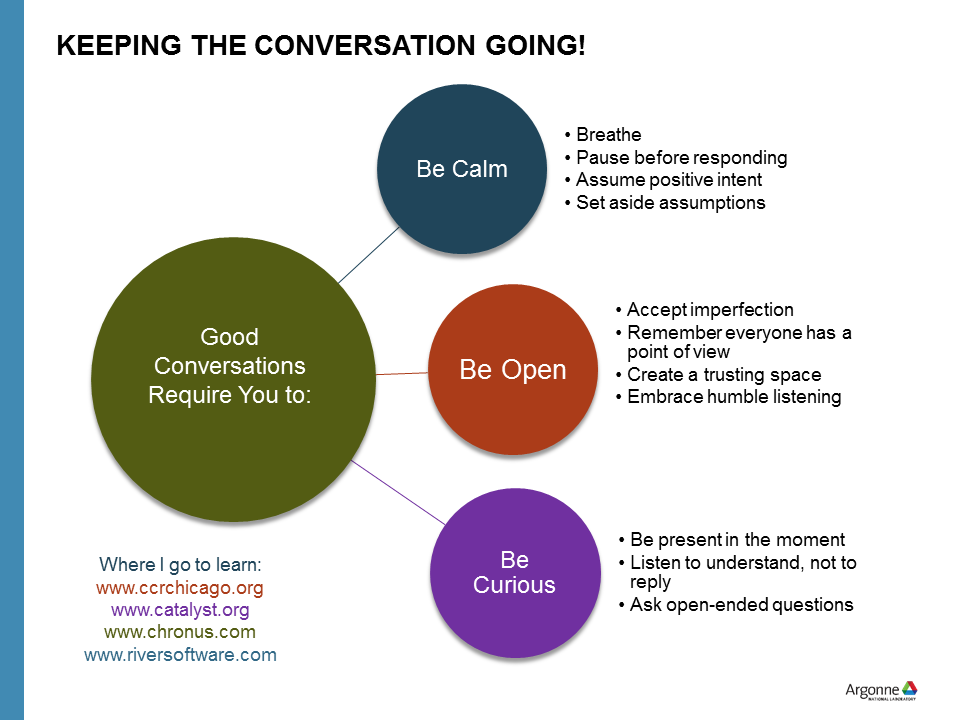
Fig. 1: Be calm, open and curious to have a good conversation.

Well, as one of the Mediation Skills coaches put it, we need to be calm, open and curious.

Being calm doesn’t mean that you anticipate a conversation will be confrontational. On the contrary, being calm allows you to clear your mind and consider what the other person is saying before you respond. A few things you can do to be calm before and during a conversation are to take a few slow, deep breaths, pause before responding and assume the other person is coming from a place of goodwill or positive intent.

Now that you are calm, you are in a position to be open. Open to what? Be open to other points of view, to making mistakes, to new ideas and questions that might come up. Be open to learning.

This takes us to the last point, which is to be curious.

Curiosity is a key skill in mentoring conversations. Curiosity probes us to want to know more. Where is the mentee coming from? How are they feeling? What is driving their issues and concerns?

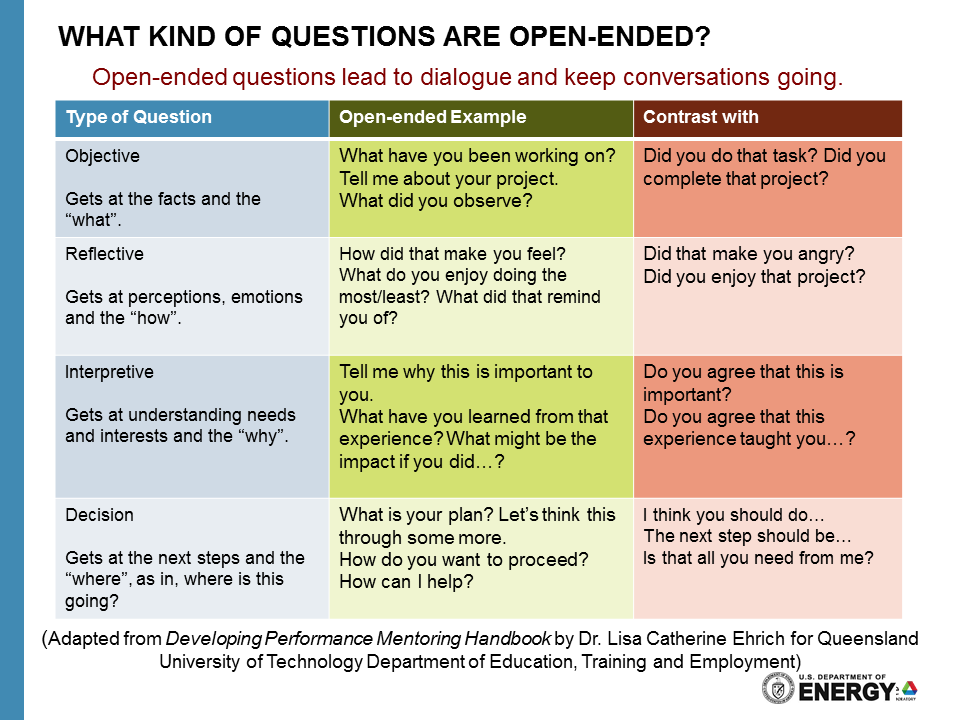
Curiosity is what allows us to ask open-ended questions. These are questions that invite more than just a yes or no answer. Open-ended questions keep the conversation going and can really get to the heart of the matter being discussed. Asking good questions is a powerful tool to foster learning.

What kind of questions should you consider asking? Well, what is it that makes you curious? What do you need to know more of? There are questions that get at the “what, why, how, where.” It all depends on what information is needed to get closer to understanding.

Examples of open-ended questions are shown in Figure 2. I also recommend two articles by Randy Emelo, Founder of River Software for mentoring solutions. These can be found on the River Software blog and at Chief Learning Officer.

Be calm. Be open. Be curious. And have yourselves some great conversations!

Figure 2: Open-ended questions invite more than yes or no answers.


Profiles in Mentoring with Maria Chan

Award winners share their thoughts on mentoring and supervision

Excellent mentors contribute not only to the development of those they mentor, but also to the success of the entire laboratory. This is why Argonne is committed to fostering a mentoring culture and recognizing employees who have made an exceptional impact as mentors.

Eight employees were honored in 2016 by the Argonne Leadership Institute for their outstanding work as mentors or supervisors. Their dedication to assisting coworkers and postdocs is a great example for those considering the role of mentor. Moreover, the Postdoctoral Mentoring Program is structured to provide each postdoc with a third-party mentor in addition to the research supervisor. Both can have a significant impact on career growth.

How do these outstanding mentors and supervisors view their roles? We asked each of this year’s honorees for some insight into their approach to good mentoring.

Peter Littlewood and Maria Chan (NST), recipient, Outstanding Postdoctoral Supervisor Award

Maria Chan received the 2016 Outstanding Postdoctoral Supervisor Award. This award recognizes exceptional work in the supervision of postdoctoral employees and in developing the next generation of scientists and engineers. Chan is an Assistant Scientist with the Nanoscience and Technology Division and a Fellow with the Computation Institute at The University of Chicago, where she is working towards the development of efficient atomistic and first principles computation methodologies, and application of such to renewable energy materials and nanoscale phenomena.

The postdoc who nominated Chan noted that her supportive guidance began during the application process, which cemented the postdoc’s decision to come to Argonne. Her nominator for the award stated that Chan “leads by example, fosters an exciting, congenial, and diverse research environment, and is genuinely interested in the success of her postdocs in both their careers and their personal lives.”

Why is a good supervisor particularly important to postdocs?      

The postdoctoral research period is a crucial time for establishing one’s research career, so positive guidance in professional and intellectual development is very important.

Did you have a supervisor who made a positive impact on your career when you were a postdoc? If so, what was that impact?

Yes. My postdoctoral supervisor Jeffrey Greeley (now at Purdue University) was tremendously inspiring and helpful when I was a postdoc. Not only did he intellectually challenge me and teach me a lot of technical knowledge in several research areas, he also showed me how to collaborate effectively which is crucial for today’s scientific research environment. In addition, dozens of scientists and professors gave me their guidance and invaluable advice when I was a postdoc, including my Ph.D. advisor Gerbrand Ceder (now at University of California Berkeley), Mike Thackeray (CSE), Stephen Gray (NST), Chris Wolverton (Northwestern), Millie Dresselhaus (MIT – now deceased), Giulia Galli (IME), and many others.

What is the most important guidance you give to postdocs?

No two postdocs are alike, so the most important guidance will depend on the individual (on this point, my very successful colleague Subramanian Sankaranarayanan also agrees). For some postdocs, it will be learning to communicate effectively. For others, it would be determining what type of work most excites them. For yet others, it would be to practice taking more risks with their ideas and trying different approaches. The list is endless.

What advice would you give to other supervisors of postdocs?

Maria Chan poses with her postdocs and mentees at the 2016 Mentor Awards Reception.

As in performing research itself, I think the most important aspects to effective supervising are to be observant and open-minded – to determine the postdoc’s needs, to listen to different opinions, and to act based on these continuous inputs.

What characteristics make for a good postdoc supervisor?

There are a lot of different ways to be effective as a supervisor also. I think good communication skills and again, open-mindedness helps.


It’s the 4th Quarter. What’s Your Game Plan?

The fourth quarter of the fiscal year can bring many challenges. You may find yourself working feverishly to finish program deliverables or finalize budget requests. Supervisors may be thinking ahead to performance discussions with employees. Postdocs are gearing up for the academic search season. For mentors and supervisors, this is also a prime time for writing letters of recommendation. Parents may be saying goodbye to children as they head off to college or school for the first time.

While the fall can bring a sense of relaxation with the change in colors and cool breezes, managing all of the year-end tasks can be stressful. Now is the time to be reaching out to mentors, supervisors and colleagues to make sure you stay on track.

One question I often hear from staff and postdocs who are new to mentoring is, “What should we talk about?” While there is no one right answer to this question, here are some tips that may help get the conversation going.

  • Are you skittish about advocating for yourself? (Don’t worry, most of us are.) Not sure how to articulate your strengths? Ask a trusted colleague or friend to re-write your resume. What would they say about you? Second opinions can be a valuable tool in answering the question, “What are your strengths?”
  • Stuck on a research problem? Ask your mentor to meet for coffee or lunch and talk it out. Just having a sounding board can generate new ideas and lead to breakthroughs.
  • Nervous about your performance discussion? Practice with a friend.
  • Are you a supervisor who will be having performance discussions with employees for the first time? Not sure where to start? Ask a more experienced colleague for advice.
  • Applying for a faculty position and want some insider tips? Peruse the Postdoc Blog for articles featuring alumni, guest columns from academics and other resources.
  • Are you supervising or mentoring a postdocs and want to equip yourself with resources to point them in the right direction? Check out the resources on the Postdoctoral Program Website.

Think about your immediate needs and your long-term goals. Think about who in your network is best poised to maximize success. Prioritize topics for discussion and take that first step. Which reminds me, Argonne is a remarkably scenic campus. Why not take that first step outside?


Miss the Mentoring Basics JumpStart Presentation?

What’s a person to do when asked to be a mentor? What does it mean to be a mentor? What are the benefits of mentoring? What responsibilities does a mentee have?

These are just a few questions we discussed at the Mentoring Basics JumpStart meeting on June 18th.

Miss the discussion and want to host it in your division or for your group? Contact Tina Henne with the Argonne Leadership Institute. Preview the slides here.

In the meantime, check out some resources available to you.

For more on Postdoc Mentoring–for both postdocs and mentors-visit the National Postdoctoral Association Website for mentoring toolkits. As a sustaining member of the NPA, Argonne staff and postdocs can join as an affiliate member for free, when registering with your Argonne email.

Got a story about mentoring to share? Let’s talk!

Video of August 5 Professional Development Armchair Conversation w/Director Peter Littlewood

Screen Shot 2014-08-14 at 9.49.25 AM

On August 5, 2014, Argonne’s Mentoring Exchange hosted An Armchair Conversation About Professional Development Opportunities and Challenges with a group of 50 employees from across the laboratory.

The conversation featured Laboratory Director Peter Littlewood, Senior Organizational Development Specialist Laura Altergott (HR), Program Leader and Senior Advisor for National and Global Security Programs and recipient of Argonne’s inaugural Outstanding Staff Mentor Award Keith Bradley (EESA), and Postdoctoral Program Coordinator Tina Henne (CEPA). Gender Diversity Specialist Erin Thomas (OTD) moderated the discussion, which explored recent successes and future challenges to developing an organizational infrastructure for robust and quality mentoring and professional development. 

If you missed the conversation or would like to experience it again, full video of the event may be found here.

About the Mentoring Exchange

Argonne’s Mentoring Exchange brings together programmatic and operations staff from all five directorates to workshop best mentoring practices and advise senior management on professional development challenges and opportunities. For more information, please email [email protected] and stay tuned to Argonne Today for future event announcements. 


The 4-1-1 on Argonne’s Mentoring Exchange

About the Mentoring Exchange

The Argonne Mentoring Exchange was launched in December 2013 to provide high-potential mentors with skill-development workshops and networking opportunities that enable community building at Argonne National Laboratory.

Cohort members meet bi-monthly and are expected to actively champion mentoring and staff development.

Fiscal Year (FY) 2014 Curriculum 

Screen Shot 2014-08-30 at 10.36.15 AM

Inaugural Cohort

Get to know members of the inaugural cohort here.

FY 2014 Selection Process

Inaugural cohort members were nominated via their Division Directors or Associate Lab Directors and all nominees were approved by the Laboratory Director.