To celebrate National Mentoring Month, we are featuring a series of guest posts reflecting on mentorship. This week’s feature from Jeremy Boldt, Manager, Learning and Organization Development with the Argonne Leadership Institute, discusses the role of emotional intelligence in mentoring.
Reflecting on my career in learning and development, as well as my mentoring experiences, both as a mentee and mentor, I’ve realized the importance of people over process. With nearly two decades in organizational learning and development, I’ve noticed a preference for structured processes and metrics. However, influenced by my humanities background (and borrowing a term from one of my Argonne colleagues), I recognize the value of the “squishy” aspects of development—those unmeasured elements that hinge on emotional intelligence.
Emotional intelligence, a concept explored through various models, highlights how our emotions and personalities impact our experiences. The Emotional Intelligence 2.0 model by Dr. Travis Bradberry and Dr. Jean Graves outlines four key skills: self-awareness, self-management, social awareness, and relationship management. These skills are crucial in mentoring:
Self-Awareness: Understand your motivations and reactions. Before seeking your mentor’s perspective on a work issue, reflect on your drivers to frame the conversation effectively.
Self-Management: Use self-awareness to manage your reactions. If something bothers you, prepare mentally before discussing it with your mentor, fostering a more productive dialogue.
Social Awareness: Focus outward to appreciate others. In mentoring, strive to understand and value your partner, enhancing the relationship and mutual learning.
Relationship Management: View mentoring as a long-term relationship. Building and maintaining a strong connection requires effort, with both parties responsible for deepening the bond.
Consider these skills as part of a continuous journey: know yourself, manage yourself, understand others, and maintain connections. Mentoring will have its challenges, but embracing discomfort and seeking honest feedback can strengthen trust and foster a robust mentoring relationship.
To celebrate National Mentoring Month, we are featuring a series of guest posts reflecting on mentorship. This week’s feature from Jeremy Boldt, Manager, Learning and Organization Development with the Argonne Leadership Institute, is about how mentoring supports learning and development goals.
In 2022, LinkedIn Learning published their report on the state of workplace learning. According to the report, “Opportunities to learn and develop new skills” was among the top five factors in employee career decisions. But what does this mean from a practical perspective? Learning and developing new skills are laudable goals, but in a sometimes frantic, change-heavy world, how can we as employees make this happen?
During my nearly 20 years in the world of learning and development, I’ve heard some variation of the phrase, “We need more training” more times than I can count. The problem with this approach is evident – more training means more time away from work, more resources, more money. And there’s no guarantee that sitting down for an online training course or traveling to an in-class workshop will help you improve your skills. Mentoring can be an excellent way to create meaningful, lasting, and timely learning opportunities that go far beyond those of traditional trainings. And it fits right in to the 70/20/10 approach to learning.
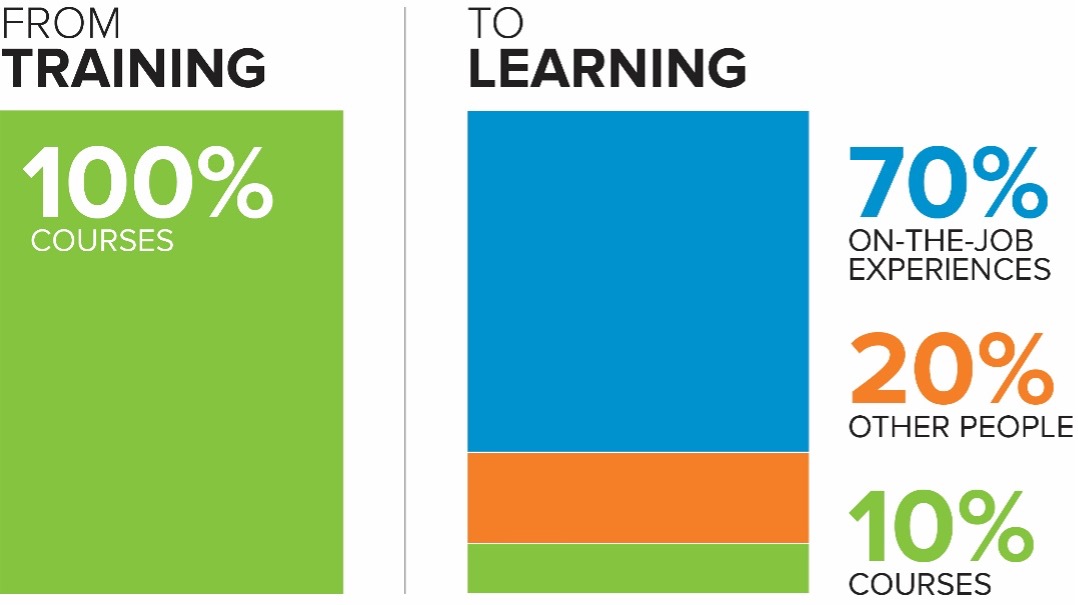
If you’re unfamiliar, the 70/20/10 model is a way to help visualize what learning can be when you think beyond traditional approaches to training (e.g., workshops, eLearning courses, etc.) According to this approach, 70% of what we learn comes from doing. Feedback from Argonne employees supports this; in our 2023 learning needs survey, 74.8% of the 522 respondents identified on-the-job experiences in their top 3 for learning opportunities. But in addition to learning by doing, it’s important for us to think about who can help us along that journey. That’s where engaging the right mentor fits in.
It’s easy to think of mentoring as limited to the 20% (relationships) of the 70/20/10 model. Truly impactful mentorship, however, can benefit your on-the-job experiences as well. When you cultivate a solid relationship with your mentor, you’ll often find a ready-made sounding board who can help guide you through your day-to-day work. Have you encountered a particular challenge? Talk to your mentor and ask them if they have ever experienced something similar. What did they do? What worked well? What didn’t work well? Have you recently taken a training course or program? Talk to your mentor about what you learned and how you think you might be able to use it. Having conversations like these not only broaden your perspectives and provide insight into the experiences of others, but it can provide you with actionable suggestions on how you can overcome barriers, address challenges, and lead yourself (and others) on a solid path forward.
Like so many things in life, you’ll get out of a mentoring relationship what you put into it. Whether you are a mentor or a mentee (and many times, they can be one and the same), remember this: mentorship is a great way to build a bridge between what we can learn in more formal settings and what we can do.
To celebrate National Mentoring Month, we are featuring a series of guest posts reflecting on mentorship. This week features advice on setting SMART goals from George Vukotich, Organization Development Lead with the Argonne Leadership Institute.
It’s a new year, which means it is time for New Year’s resolutions. Just as it can be hard to follow through on New Year’s resolutions, it can be equally as hard to follow through on our mentoring commitments. This is where SMART Goals can help.
Often individuals realize they could benefit from having someone to bounce ideas off or ask for advice, but they are not sure where to start. Even if they have someone to talk to, they are not sure what to talk about.
Have you ever been to a meeting or met with someone where it felt like you were just meeting for its own sake with no purpose? Having mentoring meetings just to meet rarely leads to productive outcomes. While it is nice to say that you have met with your mentor or mentee, the purpose of having mentoring meetings is to create productive insights on how to move your ___________ (project, career, education, etc.) forward. Without goals, time just gets burned up. While goals may change, there needs to be a starting point and a destination to strive for. By knowing what you want to achieve and having a set time to achieve it in, both the mentor and the mentee can concentrate their efforts to get where they want to be and avoid the many distractions that come up along the way.
Here’s what SMART Goals are about:
Basically, I suggest that the mentee start the process and then share what they have written down with their mentor to come to an agreement on whether the goals are realistic and how to make it happen. This may be a repetitive process, but it is better to get agreement up front than to spend time hoping that that something productive will happen.
This said, the mentoring relationship should not have too many goals. I recommend 1 to 3 over a six-month period as being manageable and realistic. It is also important to put measures in place and review the goals that have been set. A monthly check-in to evaluate progress can help, and if adjustments need to be made, changes can be made accordingly.
Getting off to a good start is the key in having a successful mentoring relationship. Start the new year off right by setting some SMART goals.
Want to know more about developing mentoring goals and a plan of action? Check out the tools developed for the Argonne Mentoring Program (login required).
As a self-proclaimed mentee, I’ve fallen victim to the unrealistic view that mentors have all the answers. On the flip side, as a mentor, I’ve had to resist the urge to blurt out solutions and answers to my mentee’s issues. While expecting or providing quick answers may seem to be an efficient way to mentor, it hardly supports the notion of mentoring as the valuable component of learning that it is.
We’ve discussed on here previously that mentors are not meant to be “fixers” and sometimes may have to take a step back and help mentees learn from mistakes. This requires conversations that bring to light what’s on the mentee’s mind and asking questions to assess understanding.
Once you’ve had an honest and open conversation with your mentee and have some ideas to explore, what’s next? In the spirit of learning, now is a good time to help your mentee generate options and do a little reality testing. Here’s what that might look like.
Consider the case in the last blog post. The conversation ended like this:
As the conversation goes on, John keeps returning to this state of frustration. You begin to suspect there is a lack of understanding between John and his manager. Your reframing response might be something like: “It sounds like having clear expectations from your boss is important to you and that you would like more feedback. Let’s think of some ways of how you might communicate this to your boss…”
Already, the mentor has given John a cue that it is time to think of some options for solving his dilemma. What might those options be? For one, he may be thinking about how to let his boss know he needs clarity around expectations for his performance. In thinking how to approach this conversation, you may ask John to consider how his boss might respond depending on how he starts the conversation. This is a type of reality testing where you ask the mentee to put themselves in the other person’s shoes or see the situation from the other person’s point of view. In this scenario, “flipping” the roles may help John come up with several ways to start the conversation.
What if after all this discussion, John decides he wants to do nothing. You might be thinking, “Maybe he just needed to vent.” Keep in mind, though, that doing nothing is an option, and as such, it needs to be reality tested. In this case, you might respond, “Okay. That is one path you can take. Let’s talk for a moment about what that might look like.” And then you may wish to encourage John to think about the consequences by asking questions such as:
What do you think will happen if you doing nothing?
How might you expect things to change?
What kind of things can you do if the situation doesn’t change?
Generating options and testing them out is about pushing brainstorming past the idea phase and into the results phase. It is about asking the “what if” and “how” type of questions. What do you think will happen if you do X? What do you think the response will be if you say Y? What is the best/worst thing that can happen if you do nothing? How will doing X, Y or Z get you closer to your goals? How do you think doing X, Y or Z will impact your current situation? What would you like to see happen and how will the proposed solution get you there?
As you and your mentee work through reality testing options, don’t forget past lessons on asking open ended questions and clarifying understanding along the way. Conversations are a journey, not a destination!
Additional reading for having productive mentoring conversations:
In the middle of grad school, I had a particularly bad thesis committee meeting. I had hit a plateau with my progress in both my research and professional growth and it showed…badly.
My committee hammered away, question after question, for which no answer seemed satisfactory. I wanted to shrink into invisibility. My graduate advisor watched the whole episode in silence.
I went home and cried, thinking this was the end. There was no way they’d let me finish my degree now. I wondered how they could do this to me? After how hard I had worked up to that point? How could my advisor let this happen to me? How could he let me fail like that?
Going back to school and facing my advisor was one of the hardest things I had to do as a graduate student. He must want me to quit, I thought. He’s trying to get me to quit. As we talked, though, I realized he wanted just the opposite. He wanted me to be successful. He wanted me to finish. But, he wanted me to “own” my work. Admittedly, I had not taken full ownership of my success yet.
Falling down like that was just the kickstart I needed to see my degree to completion. And as hard as it was for me to fail, it was just as hard for my advisor to let me fail. Luckily for me, he was invested enough in my success to help me get back up.
Secretary Perry talked about falling and failing in his visit this past week. When asked for advice to early career professionals, he told us to not be afraid to get out of our comfort zones, that it is okay to fall down and fail and that sometimes, we need people to help us get back up. And that is what mentors do.
Mentors are not there to be our “fixers.” They are there to help us grow–professionally and personally. Sometimes that growth involves learning from failure. Gifted mentors know when to step back and when to ask what we’ve learned from these occasions. They know how to let us come to our own conclusions. Mentors can offer us a hand up, but it is up to us to keep standing and move on.
I don’t recall ever thanking my graduate advisor–my mentor–for helping me get over that hump. Maybe I should. Now would be a good time to do that, as January is National Mentoring Month.
This is the perfect time to reconnect with your mentor. Ask them to coffee–and buy! Drop them a few lines to let them know what they’ve meant to you. Send them a hand-written note. Reverse the role and ask them what help you can offer. Whatever you do, take some time to honor mentors this month.
Join us on January 24th as we honor the 2017 Outstanding Mentor and Supervisor Award recipients. It’ll be a nice celebration of mentoring at the Lab. And hey, why not bring your mentor with you?
This past year, I had the pleasure of participating in a Facilitative Mediation Skills class at the Center for Conflict Resolution in Chicago. A mediator’s main jobs are to listen and to helptwo parties have a productive conversation. That’s it in a nutshell. We aren’t there to dictate answers or solutions, but to help other people, who seem to be at odds with one another, come to their own conclusions and agreement.
The reason this approach works is that when people define their own course of action, they are more likely to stick to it. The outcomes of the conversation are more achievable and sustainable when the two parties take ownership over them than if someone else just hands them the answers or tells them what to do.
I couldn’t help but see the parallels with mentoring.
As mentors, our job is not to have all the answers. We are there to help the mentee grow and develop. If we take it upon ourselves to be the “fixers”, we are not doing our mentees any favors. Instead, we need tolisten and help our mentees think through issues and concerns and carve out their own paths.
How do we do this?
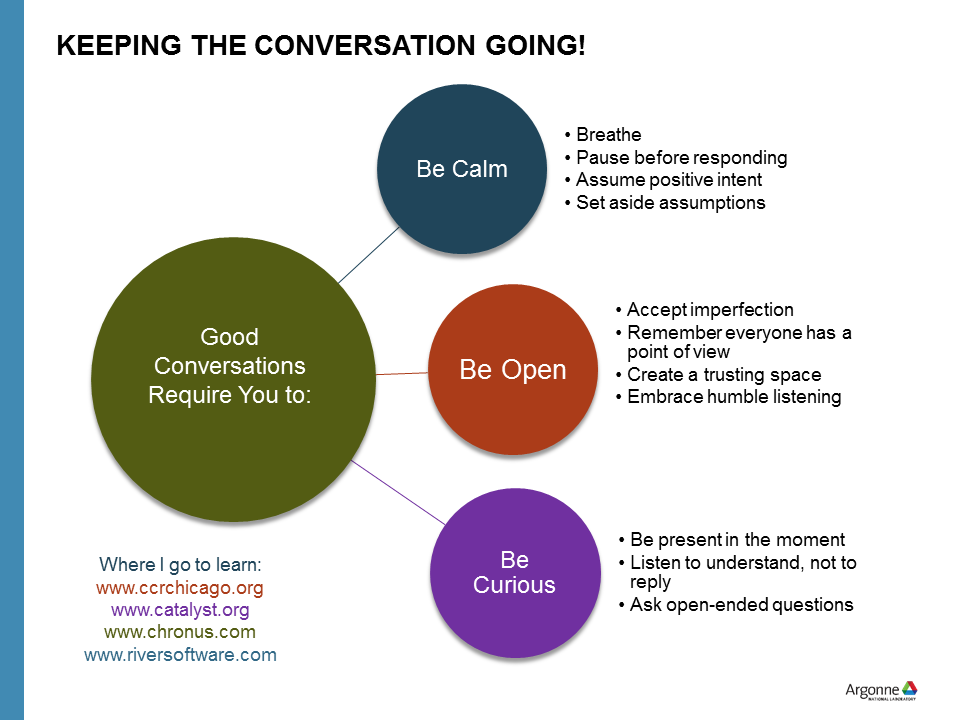
Fig. 1: Be calm, open and curious to have a good conversation.
Well, as one of the Mediation Skills coaches put it, we need to be calm, open and curious.
Being calm doesn’t mean that you anticipate a conversation will be confrontational. On the contrary, being calm allows you to clear your mind and consider what the other person is saying before you respond. A few things you can do to be calm before and during a conversation are to take a few slow, deep breaths, pause before responding and assume the other person is coming from a place of goodwill or positive intent.
Now that you are calm, you are in a position to be open. Open to what? Be open to other points of view, to making mistakes, to new ideas and questions that might come up. Be open to learning.
This takes us to the last point, which is to be curious.
Curiosity is akey skillin mentoring conversations. Curiosity probes us to want to know more. Where is the mentee coming from? How are they feeling? What is driving their issues and concerns?
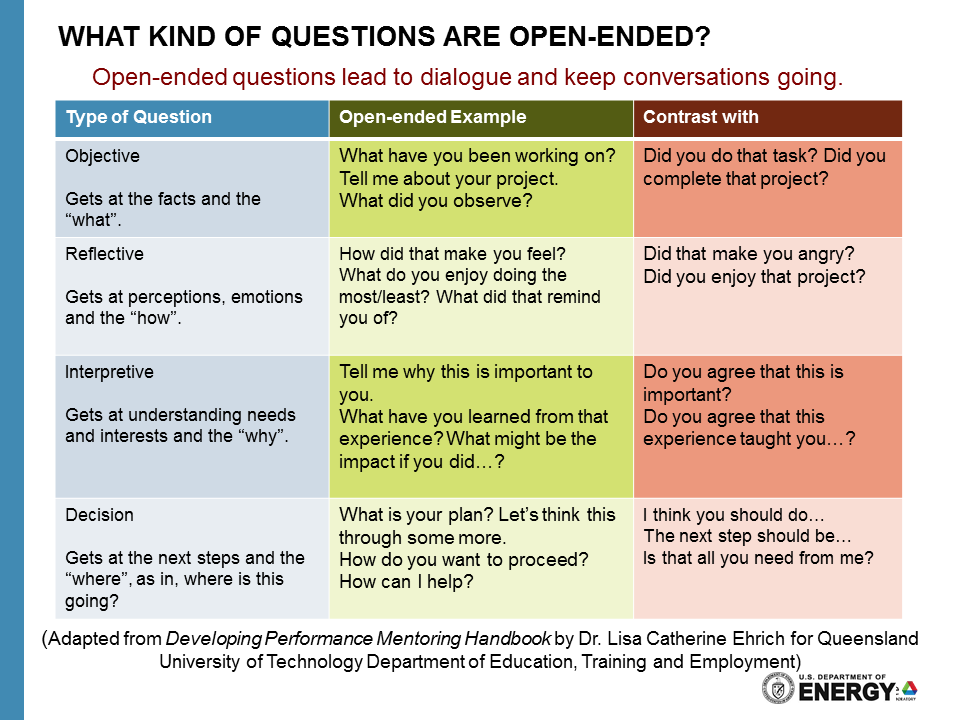
Curiosity is what allows us to ask open-ended questions. These are questions that invite more than just a yes or no answer. Open-ended questions keep the conversation going and can really get to the heart of the matter being discussed. Asking good questions is a powerful tool tofoster learning.
What kind of questions should you consider asking? Well, what is it that makes you curious? What do you need to know more of? There are questions that get at the “what, why, how, where.” It all depends on what information is needed to get closer to understanding.
Examples of open-ended questions are shown in Figure 2. I also recommend two articles by Randy Emelo, Founder of River Software for mentoring solutions. These can be foundon theRiver Software blogand atChief Learning Officer.
Be calm. Be open. Be curious. And have yourselves some great conversations!
Figure 2: Open-ended questions invite more than yes or no answers.
Excellent mentors contribute not only to the development of those they mentor, but also to the success of the entire laboratory. This is why Argonne is committed to fostering a mentoring culture and recognizing employees who have made an exceptional impact as mentors.
Eight employees were honored this year by the Argonne Leadership Institute for their outstanding work as mentors or supervisors. Their dedication to assisting coworkers and postdocs is a great example for those considering the role of mentor.
How do these outstanding mentors and supervisors view their roles? We asked each of this year’s honorees for some insight into their approach to good mentoring.
Peter Littlewood and Sang Soo Lee, honorable mention recipient, Outstanding Postdoctoral Mentor Award
Sang Soo Lee received an honorable mention for the 2016 Outstanding Postdoctoral Mentor Award. He is a geochemist in the Chemical Sciences and Engineering Division, where he works with the Interfacial Processes Group to explore in a cross-disciplinary manner the chemistry and structure of reactive solid interfaces in contact with fluids.
His nominator said, “Sang Soo Lee is an indispensable asset for the postdocs in the interfacial processes group in CSE, significantly contributing to their professional growth and helping them successfully navigate the environment here at Argonne. He cheerfully helps them with research, provides substantial career feedback, assists with administrative tasks, and much more.”
Why is mentoring particularly important in the STEM fields?
A main role of mentoring is to convey pieces of experience from a person who has gone through a similar situation to another person who hasn’t yet but will in the future, so that this person doesn’t have to spend time and effort to learn them. It is a very efficient way, so therefore very important in almost all fields.
Did you have a mentor who made a positive impact on your career?
Many people, including my supervisors in college, colleagues, friends, and family members, have provided valuable information. All of them together are/have been my mentors.
What is the benefit of having a mentor?
It is like reading a summary before reading a whole book. It makes things that will happen in the future easier to handle.
Sang Soo Lee poses with his group and mentees at the 2016 Mentor Awards Reception.
What are the most common issues mentees want to discuss with you?
What is life at Argonne like for a junior-level career scientist? What is required to be seen as a successful scientist or how to conduct independent research? Or, what would be a good path after his/her career at a national lab?
How does mentoring benefit the Argonne community as a whole?
I think it makes junior-level scientists (mostly postdocs) more realistic and more prepared.
Award winners share their thoughts on mentoring and supervision
Excellent mentors contribute not only to the development of those they mentor, but also to the success of the entire laboratory. This is why Argonne is committed to fostering a mentoring culture and recognizing employees who have made an exceptional impact as mentors.
Eight employees were honored in 2016 by the Argonne Leadership Institute for their outstanding work as mentors or supervisors. Their dedication to assisting coworkers and postdocs is a great example for those considering the role of mentor. Moreover, the Postdoctoral Mentoring Program is structured to provide each postdoc with a third-party mentor in addition to the research supervisor. Both can have a significant impact on career growth.
How do these outstanding mentors and supervisors view their roles? We asked each of this year’s honorees for some insight into their approach to good mentoring.
Ken Kemner is a recipient of the 2016 Outstanding Staff Mentor Award.
Ken Kemner received the 2016 Outstanding Staff Mentor Award. This award recognizes exceptional mentors for their ability to promote and create work environments that encourage and boost curiosity, to continuously fuel individual passions toward scientific ideas and to hold high standards for performance.
Kemner is a Senior Physicist and Group Leader in the Biosciences Division, where he leads the Molecular Environmental Science Group, an integrated multidisciplinary research group that makes use of synchrotron radiation and lab-based environmental chemistry and biology approaches for biogeochemical research to understand the complex processes that affect the cycling of key nutrients and the movement of contaminants in the subsurface environment.
The staff member who nominated Kemner describes Ken as a “tireless advocate” who always kept a focus on the future and the nominator’s development as a scientist. The nominator notes, “I met and talked with more scientists in my first year with Ken than I did in 6 years of graduate school, transforming names I had once known only from journal articles into friends and colleagues.”
Why is mentoring particularly important in your field?
Biogeochemistry and Environmental Science are inherently a multidisciplinary fields that includes Biology, Geology, Chemistry, Physics, and Modeling (just to name a few). Each of these disciplines bring a different perspective to how research is performed and expectations as to how researchers interact. It is not reasonable to assume that all early career scientists will have the experience and background in all of these research fields. Therefore, a mentor who has the experience of collaboratively working with researchers from these many different fields can be a very valuable asset to the early career scientist.
Did you have a mentor who made a positive impact on your career?
I did not have just one mentor that has made a positive impact on my career. I have had at least three over the past 25 years. Each of them have continued to provide their counsel and perspectives to me to this day.
What is the benefit of having a mentor?
Early in my career I benefitted from mentors who provided guidance and suggestions about how to develop my research program. Later in my career, my relationship with those same mentors has evolved from a student-teacher type of relationship to a “fellow colleague” type of relationship in which the mentor provides their perspective and opinions which helps increase the chances that I have numerous perspectives about something before making a decision.
What is the benefit of being a mentor?
As a mentor, I benefit from the mentee by learning more about their perspectives on numerous topics. In addition, as a mentor, discussions with mentees ensures that I am continually reevaluating my perspectives on the many topics of discussion that I have with the mentee.
Ken poses with colleagues and mentees from his group in the Biosciences Division.
What prompted you to become a mentor?
I wanted to give back to the “system” all that had been given to me. With that said, I don’t think I sought the opportunity to be a mentor. Rather, the opportunities presented themselves to me and I accepted them.
What are the most common issues mentees want to discuss with you?
Although I collaborate with many of the people I mentor and we often discuss science, a common interest of most mentees are issues related to career development, particularly those related securing a research/faculty position beyond a postdoctoral appointment.
How does mentoring benefit the Argonne community as a whole?
Usually, those who are mentors value the “service to others” aspect of mentoring. Thus, through their mentoring and by their example, mentors are setting tone of “service to others” at the Laboratory which I think is a good thing to do.
Award winners share their thoughts on mentoring and supervision
Excellent mentors contribute not only to the development of those they mentor, but also to the success of the entire laboratory. This is why Argonne is committed to fostering a mentoring culture and recognizing employees who have made an exceptional impact as mentors.
Eight employees were honored in 2016 by the Argonne Leadership Institute for their outstanding work as mentors or supervisors. Their dedication to assisting coworkers and postdocs is a great example for those considering the role of mentor. Moreover, the Postdoctoral Mentoring Program is structured to provide each postdoc with a third-party mentor in addition to the research supervisor. Both can have a significant impact on career growth.
How do these outstanding mentors and supervisors view their roles? We asked each of this year’s honorees for some insight into their approach to good mentoring.
Peter Littlewood and Maria Chan (NST), recipient, Outstanding Postdoctoral Supervisor Award
Maria Chan received the 2016 Outstanding Postdoctoral Supervisor Award. This award recognizes exceptional work in the supervision of postdoctoral employees and in developing the next generation of scientists and engineers. Chan is an Assistant Scientist with the Nanoscience and Technology Division and a Fellow with the Computation Institute at The University of Chicago, where she is working towards the development of efficient atomistic and first principles computation methodologies, and application of such to renewable energy materials and nanoscale phenomena.
The postdoc who nominated Chan noted that her supportive guidance began during the application process, which cemented the postdoc’s decision to come to Argonne. Her nominator for the award stated that Chan “leads by example, fosters an exciting, congenial, and diverse research environment, and is genuinely interested in the success of her postdocs in both their careers and their personal lives.”
Why is a good supervisor particularly important to postdocs?
The postdoctoral research period is a crucial time for establishing one’s research career, so positive guidance in professional and intellectual development is very important.
Did you have a supervisor who made a positive impact on your career when you were a postdoc? If so, what was that impact?
Yes. My postdoctoral supervisor Jeffrey Greeley (now at Purdue University) was tremendously inspiring and helpful when I was a postdoc. Not only did he intellectually challenge me and teach me a lot of technical knowledge in several research areas, he also showed me how to collaborate effectively which is crucial for today’s scientific research environment. In addition, dozens of scientists and professors gave me their guidance and invaluable advice when I was a postdoc, including my Ph.D. advisor Gerbrand Ceder (now at University of California Berkeley), Mike Thackeray (CSE), Stephen Gray (NST), Chris Wolverton (Northwestern), Millie Dresselhaus (MIT – now deceased), Giulia Galli (IME), and many others.
What is the most important guidance you give to postdocs?
No two postdocs are alike, so the most important guidance will depend on the individual (on this point, my very successful colleague Subramanian Sankaranarayanan also agrees). For some postdocs, it will be learning to communicate effectively. For others, it would be determining what type of work most excites them. For yet others, it would be to practice taking more risks with their ideas and trying different approaches. The list is endless.
What advice would you give to other supervisors of postdocs?
Maria Chan poses with her postdocs and mentees at the 2016 Mentor Awards Reception.
As in performing research itself, I think the most important aspects to effective supervising are to be observant and open-minded – to determine the postdoc’s needs, to listen to different opinions, and to act based on these continuous inputs.
What characteristics make for a good postdoc supervisor?
There are a lot of different ways to be effective as a supervisor also. I think good communication skills and again, open-mindedness helps.
In today’s fast-paced, action-packed world, it can be hard to keep up with awareness days, weeks, or months. It seems there is a day, week or month for just about everything. While this can seem overwhelming, these designated times of awareness are good opportunities to reflect on the themedu jour and how it might apply to us.
May is Mental Health Month and as such, it is a perfect time to take a moment and reflect on ourselves and each other. Naturejobs Blog contributor Jack Leemy captured tips from psychologist Karra Harrington in a recent post. While the target audience is graduate students, the piece provides advice applicable to all. I encourage you to give it a quick read.
In particular, Ms. Harrington advises investing in a support network, seeking out peer and mentor relationships and finding out what resources are available to you and how to find them. These are all good points.
Look around. Who counts as your support network? With whom have you developed relationships? Who are your trusted friends and mentors? Are you a part of someone else’s support network? Who are your peers, who might be able to speak to your experiences?
One way to expand your network is to get involved in one of the many employee resource groups (ERG) at Argonne. You can find links to Women in Science and Technology Program (WIST), the Argonne African American (AAA) ERG, Spectrum, Chinese Association at Argonne and the Hispanic-Latino Club at the Leadership Institute’s Diversity and Inclusion page. Also, there is a new group for early career employees that is just getting up and running. As the Postdoctoral Program Lead, I am also here as a resource for postdocs, mentors and supervisors who might need some guidance on where to find resources.
Remember, too, that the lab provides the Employee Assistance Program as a benefit to all employees. The program is provided by Perspectives, Ltd., and provides a host of resources, self-directed learning opportunities, in addition to help connecting with a professional. The wellness app, Virgin Pulse, is another avenue to explore maintaining a healthy mindset and learn strategies for managing stress and being resilient.
Ms. Harrington ends her post by advising readers to ask for help and ask early. Connect with a colleague, forge a mentoring relationship, talk to a peer. Remember, we are all in this together.