Mentoring Skills Tune-Up—Assessing Understanding

When I was a Postdoctoral Appointee I had the opportunity to mentor a summer student. My supervisor had cautioned that taking on a student could be a lot of work, but if I was up to it, she’d support me. Seeing it as an opportunity to build my own mentoring skills and add a spark of life to our lab, I accepted the challenge. My student mentee was eager to learn and asked a lot of questions that forced me to go back to the basics and make sure I understood fundamental concepts behind the techniques we used. In turn, I asked her a lot of questions to assess her understanding of what we were doing to make sure she got the “big picture” and was comfortable performing experiments. It was a fun and educational experience for both of us!

There are different techniques you can use to assess understanding of procedures and techniques. Being a visual learner, drawing diagrams is one of my favorites. When it comes to mentoring conversations that are not centered on a process or procedure though, assessing understanding can present unique challenges.

Recently, we explored how to plan mentoring conversations and the use of questions and curiosity to keep conversations going. But what happens if you sense that you and your mentee are no longer on the same wavelength? What can you do if you feel the conversation has drifted off track? How will you respond if your mentee expresses frustration that you are not understanding?

While not as straightforward as drawing diagrams—which could help, by the way—there are tools to assess and affirm understanding in conversations. Two such tools that are used in the mediation field are summarizing and reframing. These dovetail nicely with active listening and asking open-ended questions and can help get over hurdles that are impeding progress in your mentoring relationship.

Summarizing

Summarizing is different than simply repeating back what you heard. When you summarize, you are providing an abbreviated version of what your mentee articulated. It captures the salient points, so listen for key words and those points conveyed with greater emotion. When you summarize your mentee’s message, you provide a chance for clarification and affirm that you are listening. You can ask, “Did I get that right?” This is a good technique to reuse throughout your mentoring conversations to make sure you and your mentee are making progress towards your goals. Summarizing can lead to new questions and set up the next step in your mentoring journey.

Reframing

Reframing is a technique that can be used to assess and affirm understanding, acknowledge emotions and help move from a state of negativity towards one focused on moving forward. Reframing statements might begin with, “What I am hearing from you is…” or “It sounds to me like you…” This recognizes your role in building understanding and again, provides a chance for the mentee to make clarifications. Reframing is a way to take a complaint or negative position and state it in such a way that the goal now becomes one of problem solving.

For example, consider the following scenario, adapted from the Beyond Mentoring toolkit developed for the National Postdoctoral Association.

John, your mentee, has been having trouble understanding his manager’s expectations for his work deliverables. John is very talkative and sees himself as someone who can get along with anyone. He is having a hard time understanding why his manager “doesn’t like him.”  They have weekly meetings where he goes into great detail of all that he’s done, including things that worked and didn’t work.  His manager is not as talkative and doesn’t say much in the meetings. When she does, she gives John the impression that he’s not working on the right things or is on the wrong track. John starts off your mentor meeting telling you about the latest pitfalls. It is clear from his body language that he is frustrated. He is slouching, shaking his head and rolling his eyes at times. “No matter what I do, it never seems to be right!” he says. “We meet every week and it’s always something new. And to make it worse, I’m never quite sure what I’m doing wrong. I’m working hard and doing a lot, but getting nowhere with my boss. I just can’t seem to win.”

As the conversation goes on, John keeps returning to this state of frustration. You begin to suspect there is a lack of understanding between John and his manager. Your reframing response might be something like: “It sounds like having clear expectations from your boss is important to you and that you would like more feedback. Let’s think of some ways of how you might communicate this to your boss…”

In the reframed response, you captured the main issues (unclear expectations and feedback) and shifted the mindset from a cycle of frustration (“I can’t win”) to one of problem solving (“Let’s think of some ways…”). This puts your mentee in a position to learn and grow, while at the same time, communicates that you understand not only the issue, but also how he feels about it.

Assessing understanding is key to cultivating mentoring relationships. It is part of maintaining effective communication, which is a pillar of effective mentoring. For this and more on cultivating relationships, the University of Wisconsin Institute for Clinical Translational Research offers a good starting point for further reading. The information and linked resources are applicable to any mentoring scenario—not just research mentoring. Check it out!
It’s National Mentoring Month! What Is Your Memorable Mentoring Moment?

In the middle of grad school, I had a particularly bad thesis committee meeting. I had hit a plateau with my progress in both my research and professional growth and it showed…badly.

My committee hammered away, question after question, for which no answer seemed satisfactory. I wanted to shrink into invisibility. My graduate advisor watched the whole episode in silence.

I went home and cried, thinking this was the end. There was no way they’d let me finish my degree now. I wondered how they could do this to me? After how hard I had worked up to that point? How could my advisor let this happen to me? How could he let me fail like that?

Going back to school and facing my advisor was one of the hardest things I had to do as a graduate student. He must want me to quit, I thought. He’s trying to get me to quit. As we talked, though, I realized he wanted just the opposite. He wanted me to be successful. He wanted me to finish. But, he wanted me to “own” my work. Admittedly, I had not taken full ownership of my success yet.

Falling down like that was just the kickstart I needed to see my degree to completion. And as hard as it was for me to fail, it was just as hard for my advisor to let me fail. Luckily for me, he was invested enough in my success to help me get back up.

Secretary Perry talked about falling and failing in his visit this past week. When asked for advice to early career professionals, he told us to not be afraid to get out of our comfort zones, that it is okay to fall down and fail and that sometimes, we need people to help us get back up. And that is what mentors do.

Mentors are not there to be our “fixers.” They are there to help us grow–professionally and personally. Sometimes that growth involves learning from failure. Gifted mentors know when to step back and when to ask what we’ve learned from these occasions. They know how to let us come to our own conclusions. Mentors can offer us a hand up, but it is up to us to keep standing and move on.

I don’t recall ever thanking my graduate advisor–my mentor–for helping me get over that hump. Maybe I should. Now would be a good time to do that, as January is National Mentoring Month.

This is the perfect time to reconnect with your mentor. Ask them to coffee–and buy! Drop them a few lines to let them know what they’ve meant to you. Send them a hand-written note. Reverse the role and ask them what help you can offer. Whatever you do, take some time to honor mentors this month.

Join us on January 24th as we honor the 2017 Outstanding Mentor and Supervisor Award recipients. It’ll be a nice celebration of mentoring at the Lab. And hey, why not bring your mentor with you?

Curiouser and Curiouser! Asking Questions to Keep the Conversation Going

“Curiouser and curiouser!” Cried Alice (she was so much surprised, that for the moment she quite forgot how to speak good English).”
― Lewis Carroll, Alice’s Adventures in Wonderland & Through the Looking-Glass

This past year, I had the pleasure of participating in a Facilitative Mediation Skills class at the Center for Conflict Resolution in Chicago. A mediator’s main jobs are to listen and to help two parties have a productive conversation. That’s it in a nutshell. We aren’t there to dictate answers or solutions, but to help other people, who seem to be at odds with one another, come to their own conclusions and agreement.

The reason this approach works is that when people define their own course of action, they are more likely to stick to it. The outcomes of the conversation are more achievable and sustainable when the two parties take ownership over them than if someone else just hands them the answers or tells them what to do.

I couldn’t help but see the parallels with mentoring.

As mentors, our job is not to have all the answers. We are there to help the mentee grow and develop. If we take it upon ourselves to be the “fixers”, we are not doing our mentees any favors. Instead, we need to listen and help our mentees think through issues and concerns and carve out their own paths.

How do we do this?

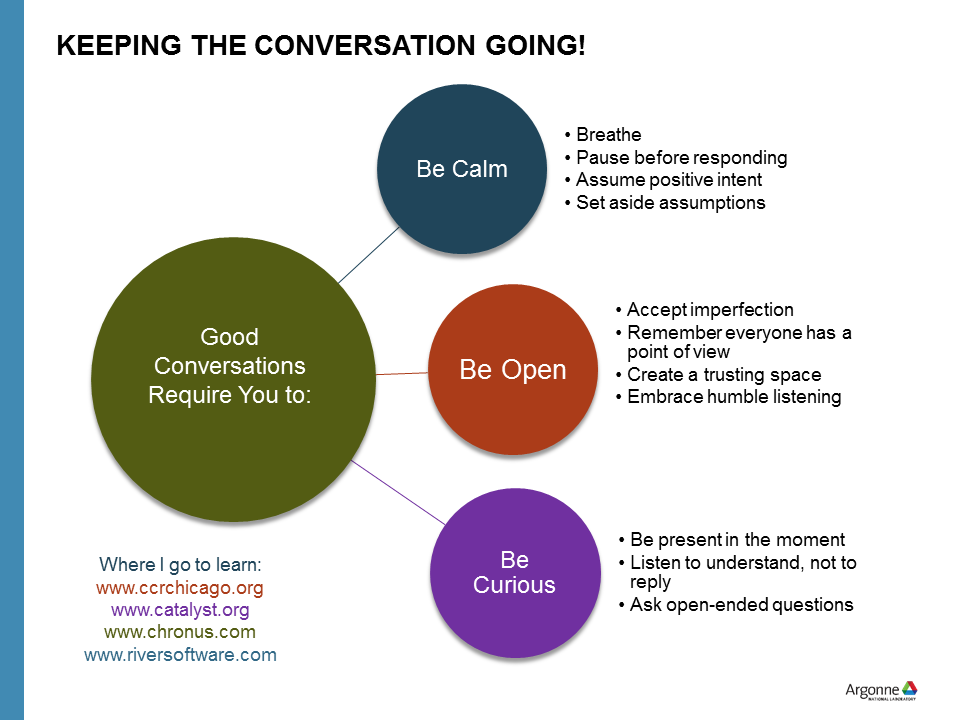
Fig. 1: Be calm, open and curious to have a good conversation.

Well, as one of the Mediation Skills coaches put it, we need to be calm, open and curious.

Being calm doesn’t mean that you anticipate a conversation will be confrontational. On the contrary, being calm allows you to clear your mind and consider what the other person is saying before you respond. A few things you can do to be calm before and during a conversation are to take a few slow, deep breaths, pause before responding and assume the other person is coming from a place of goodwill or positive intent.

Now that you are calm, you are in a position to be open. Open to what? Be open to other points of view, to making mistakes, to new ideas and questions that might come up. Be open to learning.

This takes us to the last point, which is to be curious.

Curiosity is a key skill in mentoring conversations. Curiosity probes us to want to know more. Where is the mentee coming from? How are they feeling? What is driving their issues and concerns?

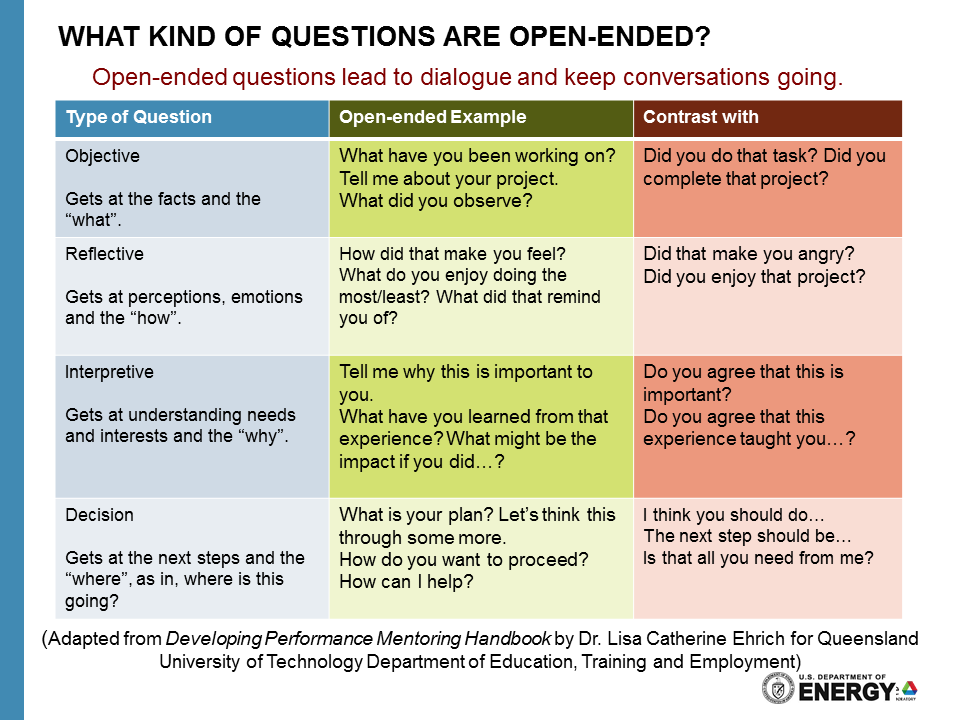
Curiosity is what allows us to ask open-ended questions. These are questions that invite more than just a yes or no answer. Open-ended questions keep the conversation going and can really get to the heart of the matter being discussed. Asking good questions is a powerful tool to foster learning.

What kind of questions should you consider asking? Well, what is it that makes you curious? What do you need to know more of? There are questions that get at the “what, why, how, where.” It all depends on what information is needed to get closer to understanding.

Examples of open-ended questions are shown in Figure 2. I also recommend two articles by Randy Emelo, Founder of River Software for mentoring solutions. These can be found on the River Software blog and at Chief Learning Officer.

Be calm. Be open. Be curious. And have yourselves some great conversations!

Figure 2: Open-ended questions invite more than yes or no answers.


Profiles in Mentoring with Ken Kemner

Award winners share their thoughts on mentoring and supervision

Excellent mentors contribute not only to the development of those they mentor, but also to the success of the entire laboratory. This is why Argonne is committed to fostering a mentoring culture and recognizing employees who have made an exceptional impact as mentors.

Eight employees were honored in 2016 by the Argonne Leadership Institute for their outstanding work as mentors or supervisors. Their dedication to assisting coworkers and postdocs is a great example for those considering the role of mentor. Moreover, the Postdoctoral Mentoring Program is structured to provide each postdoc with a third-party mentor in addition to the research supervisor. Both can have a significant impact on career growth.

How do these outstanding mentors and supervisors view their roles? We asked each of this year’s honorees for some insight into their approach to good mentoring.

Ken Kemner is a recipient of the 2016 Outstanding Staff Mentor Award.

Ken Kemner received the 2016 Outstanding Staff Mentor Award. This award recognizes exceptional mentors for their ability to promote and create work environments that encourage and boost curiosity, to continuously fuel individual passions toward scientific ideas and to hold high standards for performance.

Kemner is a Senior Physicist and Group Leader in the Biosciences Division, where he leads the Molecular Environmental Science Group, an integrated multidisciplinary research group that makes use of synchrotron radiation and lab-based environmental chemistry and biology approaches for biogeochemical research to understand the complex processes that affect the cycling of key nutrients and the movement of contaminants in the subsurface environment.

The staff member who nominated Kemner describes Ken as a “tireless advocate” who always kept a focus on the future and the nominator’s development as a scientist. The nominator notes, “I met and talked with more scientists in my first year with Ken than I did in 6 years of graduate school, transforming names I had once known only from journal articles into friends and colleagues.”

Why is mentoring particularly important in your field?

Biogeochemistry and Environmental Science are inherently a multidisciplinary fields that includes Biology, Geology, Chemistry, Physics, and Modeling (just to name a few).  Each of these disciplines bring a different perspective to how research is performed and expectations as to how researchers interact.  It is not reasonable to assume that all early career scientists will have the experience and background in all of these research fields.  Therefore, a mentor who has the experience of collaboratively working with researchers from these many different fields can be a very valuable asset to the early career scientist.

Did you have a mentor who made a positive impact on your career?

I did not have just one mentor that has made a positive impact on my career.  I have had at least three over the past 25 years.  Each of them have continued to provide their counsel and perspectives to me to this day.

What is the benefit of having a mentor?

Early in my career I benefitted from mentors who provided guidance and suggestions about how to develop my research program.  Later in my career, my relationship with those same mentors has evolved from a student-teacher type of relationship to a “fellow colleague” type of relationship in which the mentor provides their perspective and opinions which helps increase the chances that I have numerous perspectives about something before making a decision.

What is the benefit of being a mentor?

As a mentor, I benefit from the mentee by learning more about their perspectives on numerous topics.  In addition, as a mentor, discussions with mentees ensures that I am continually reevaluating my perspectives on the many topics of discussion that I have with the mentee.

Ken poses with colleagues and mentees from his group in the Biosciences Division.

What prompted you to become a mentor?

I wanted to give back to the “system” all that had been given to me.  With that said, I don’t think I sought the opportunity to be a mentor.  Rather, the opportunities presented themselves to me and I accepted them.

What are the most common issues mentees want to discuss with you?

Although I collaborate with many of the people I mentor and we often discuss science, a common interest of most mentees are issues related to career development, particularly those related securing a research/faculty position beyond a postdoctoral appointment.

How does mentoring benefit the Argonne community as a whole?

Usually, those who are mentors value the “service to others” aspect of mentoring.  Thus, through their mentoring and by their example, mentors are setting tone of “service to others” at the Laboratory which I think is a good thing to do.


Profiles in Mentoring with Maria Chan

Award winners share their thoughts on mentoring and supervision

Excellent mentors contribute not only to the development of those they mentor, but also to the success of the entire laboratory. This is why Argonne is committed to fostering a mentoring culture and recognizing employees who have made an exceptional impact as mentors.

Eight employees were honored in 2016 by the Argonne Leadership Institute for their outstanding work as mentors or supervisors. Their dedication to assisting coworkers and postdocs is a great example for those considering the role of mentor. Moreover, the Postdoctoral Mentoring Program is structured to provide each postdoc with a third-party mentor in addition to the research supervisor. Both can have a significant impact on career growth.

How do these outstanding mentors and supervisors view their roles? We asked each of this year’s honorees for some insight into their approach to good mentoring.

Peter Littlewood and Maria Chan (NST), recipient, Outstanding Postdoctoral Supervisor Award

Maria Chan received the 2016 Outstanding Postdoctoral Supervisor Award. This award recognizes exceptional work in the supervision of postdoctoral employees and in developing the next generation of scientists and engineers. Chan is an Assistant Scientist with the Nanoscience and Technology Division and a Fellow with the Computation Institute at The University of Chicago, where she is working towards the development of efficient atomistic and first principles computation methodologies, and application of such to renewable energy materials and nanoscale phenomena.

The postdoc who nominated Chan noted that her supportive guidance began during the application process, which cemented the postdoc’s decision to come to Argonne. Her nominator for the award stated that Chan “leads by example, fosters an exciting, congenial, and diverse research environment, and is genuinely interested in the success of her postdocs in both their careers and their personal lives.”

Why is a good supervisor particularly important to postdocs?      

The postdoctoral research period is a crucial time for establishing one’s research career, so positive guidance in professional and intellectual development is very important.

Did you have a supervisor who made a positive impact on your career when you were a postdoc? If so, what was that impact?

Yes. My postdoctoral supervisor Jeffrey Greeley (now at Purdue University) was tremendously inspiring and helpful when I was a postdoc. Not only did he intellectually challenge me and teach me a lot of technical knowledge in several research areas, he also showed me how to collaborate effectively which is crucial for today’s scientific research environment. In addition, dozens of scientists and professors gave me their guidance and invaluable advice when I was a postdoc, including my Ph.D. advisor Gerbrand Ceder (now at University of California Berkeley), Mike Thackeray (CSE), Stephen Gray (NST), Chris Wolverton (Northwestern), Millie Dresselhaus (MIT – now deceased), Giulia Galli (IME), and many others.

What is the most important guidance you give to postdocs?

No two postdocs are alike, so the most important guidance will depend on the individual (on this point, my very successful colleague Subramanian Sankaranarayanan also agrees). For some postdocs, it will be learning to communicate effectively. For others, it would be determining what type of work most excites them. For yet others, it would be to practice taking more risks with their ideas and trying different approaches. The list is endless.

What advice would you give to other supervisors of postdocs?

Maria Chan poses with her postdocs and mentees at the 2016 Mentor Awards Reception.

As in performing research itself, I think the most important aspects to effective supervising are to be observant and open-minded – to determine the postdoc’s needs, to listen to different opinions, and to act based on these continuous inputs.

What characteristics make for a good postdoc supervisor?

There are a lot of different ways to be effective as a supervisor also. I think good communication skills and again, open-mindedness helps.


Tip Sheets for Mentoring and Being Mentored

When the Postdoctoral Program Office started the Postdoctoral Mentoring Program almost seven years ago, one of the most common questions we would get was, “So, how does mentoring work?” While fundamental in nature, this is actually a good question.

Some people are just naturally good mentors. For most of us, it helps to have an idea of where and how to begin. It’s no wonder then, that the internet abounds with advice, resources and guidance for mentors and mentees. One of my favorite sites for information on mentoring in the business world, Management Mentors, even has a list of “commandments” for mentors and mentees.

It is not my style to command anyone to do anything, but I am a fan of checklists and tip sheets. Whether you are a postdoc or staff, in a research role or administrative role, mentor or mentee, etc., there are overarching themes that are important to building effective mentoring relationships. Some of the essential components are setting expectations, assessing fit and maintaining good communication.

We’ve covered these concepts in past workshops and JumpStart presentations and will continue to build on these concepts. In the meantime, take advantage of the checklists for mentors and mentees at the Leadership Institute’s Mentoring page.

If you have a good tip, article or anecdote to share, email it to [email protected] so we can share it with the Argonne community.

Now go forth and mentor!


Mentoring Compacts Can Be Useful Tools for Research Supervisors

Argonne’s Postdoctoral Mentoring Program is unique in that postdoctoral researchers report to a supervisor or line manager for their research and employment functions, and have a third party mentor outside of line management. This structure is to ensure that every postdoc has the opportunity to gain additional insight and advice and to help grow their network at the lab. We have talked before about key elements, resources and tools for maintaining good mentoring relationships. These concepts can apply to supervisory relationships as well.

One such tool is the mentoring compact, also called mentoring agreements or contracts. What is a mentoring compact? It is a document that establishes guidelines for both the mentor and mentee so each are clear on what they are committing to and what they can expect from each other. There are examples of compacts available online. Let’s walk through a few key elements of a compact’s content and use.

What information should you include?

From the perspective of a supervisor, think about what you want new members to your group to know about the work culture, expectations for team participation, and maintaining open communication channels on research progress. Some questions to ask yourself include but are not limited to:

  • How often do you expect to meet with your direct reports? What should they bring with them to guide the discussions?
  • What are the preferred communication channels?
  • What is the timeline for research deliverables?
  • What feedback can your postdocs expect of you?
  • How does your group manage data, including ownership of data, hand-off of projects and publication authorship?
  • What are you prepared to offer to support professional development and career readiness for your postdocs?
  • What are the expectations for maintaining a positive, professional and ethical working environment?

As a postdoc or mentee, you will want to echo understanding of the above and consider what you are prepared to commit to. Ask yourself the following:

  • Do you understand the dynamics of your new group and how you can contribute to team success?
  • Do you understand the expectations for being a good lab/group citizen and how to address issues that arise?
  • Have you articulated your professional development needs with your supervisor and are you prepared to take ownership for your development?
  • Are the expectations for authorship clear and do you agree with the strategy for publishing results?
  • How will you communicate progress on your research? What feedback do you need? Have you made that clear?

How should you use a mentoring compact?

Consider a compact to be a living document. When a new member joins your group, provide the compact to them and then schedule a follow-up meeting to discuss it. You may wish to customize it further based on your discussion. New postdocs and supervisors are expected to have an initial discussion to cover research and career objectives. That would be a good time to go over the compact.

Don’t toss it in a drawer after that! Review it together periodically, especially when it comes time to follow through on deliverables and professional development activities, or when communication issues arise. What did you both agree to? Are expectations being followed?

Where can you learn more about mentoring compacts?

The University of Wisconsin Institute for Clinical and Translational Research (ISTCR) has a nice checklist of suggestions for what to cover in a mentoring compact. They also have ready-made examples for compacts between individuals, for teams or for developing compacts based on key questions.

The Association of American Medical Colleges Graduate Group on Graduate Research, Education, and Training (GREAT Group) has a good framework for developing and using mentoring compacts, complete with a mentoring compact available for download that has common expectations for postdocs and mentors.

I encourage you to check out the resources linked above. While written from the perspective of biomedical researchers, they are perfectly adaptable to any discipline. Don’t reinvent the wheel!


Profiles in Mentoring with Sibendu Som

Award winners share their thoughts on mentoring and supervision

Excellent mentors contribute not only to the development of those they mentor, but also to the success of the entire laboratory. This is why Argonne is committed to fostering a mentoring culture and recognizing employees who have made an exceptional impact as mentors.

Eight employees were honored in 2016 by the Argonne Leadership Institute for their outstanding work as mentors or supervisors. Their dedication to assisting coworkers and postdocs is a great example for those considering the role of mentor. Moreover, the Postdoctoral Mentoring Program is structured to provide each postdoc with a third-party mentor in addition to the research supervisor. Both can have a significant impact on career growth.

How do these outstanding mentors and supervisors view their roles? We asked each of this year’s honorees for some insight into their approach to good mentoring.

Peter Littlewood and Sibendu Som (ES), recipient, Outstanding Postdoctoral Supervisor Award

Sibendu Som received the 2016 Outstanding Postdoctoral Supervisor Award. Som is a Lead Computational Scientist in the Energy Systems Division and principal investigator for developing predictive spray and combustion modeling capabilities for compression ignition engines.

His nominator for the award stated, “I believe Sibendu deserves this award based on his consistent, high-quality, unbiased mentorship, which has directly led to my professional success at Argonne.”

Why is a good supervisor particularly important to postdocs?

Postdoctoral candidates come to Argonne to shape their careers. It is the responsibility of a supervisor to ensure the postdoc is able to work on projects that help them gain necessary expertise for career growth, either at Argonne or elsewhere.

Did you have a supervisor who made a positive impact on your career when you were a postdoc? If so, what was that impact?

Yes, my postdoc and current supervisor Doug Longman has been influential in my career growth at Argonne. He encouraged me to develop collaborations both internally within the laboratory and externally with other national labs, universities and engine companies. This has resulted in creation of the VERIFI program at Argonne which has been largely successful in attracting industry to work together with Argonne for engine simulations.

What is the most important guidance you give to postdocs?

I spend lot of time with postdocs to develop new skills. In addition to providing them technical guidance on research tasks, I strongly encourage them to participate in grant writing (LDRD, white paper and FOAs), participate in postdoc society activities at Argonne, improve presentation/communication skills by going through the Toastmasters program. I also try to impart a sense of what technical work can bring the most return on investment (ROI). Every problem is an interesting research topic, but I help postdocs identify what would have the most ROI in terms of publication, future funding etc.

What advice would you give to other supervisors of postdocs?

Sibendu Som poses with his postdocs and mentees at the 2016 Mentor Awards Reception.

I encourage all supervisors to dedicate some amount of their time to understanding the personal aspirations of each postdoc candidate and try as much as possible to best align them with research projects. Supervisors should also be open to introduce the postdocs to their own professional network.

What characteristics make for a good postdoc supervisor?

The ability to listen to the postdoc, encourage and then develop their thoughts into ideas is a very important characteristic of a supervisor. I also think the ability to align different projects with postdocs’ expertise and career growth interests is important.

National Mentoring Month and #ThankYourMentor Day

January is National Mentoring Month. As noted in the Presidential Proclamation, this month is a time to “reflect on the transformative role mentorship can play and acknowledge the many ways that mentors have helped our next generation of leaders and innovators grow.” As we kick off a new year, it is fitting that we think about our hopes and goals and how our mentors have helped us along the way. It is also a time to consider how we might be mentors to others.

As part of the celebration of mentoring this month, January 19th has been designated National #ThankYourMentor Day. I encourage each of you to reach out to your mentors and tell them what they have meant to you.

This year, #ThankYourMentor Day is bittersweet for me. Just this past weekend, one of my cherished mentors, Dr. Susan Karcher, passed away after a battle with cancer. I’d like to share with you why I feel compelled to thank Dr. Karcher.

As a graduate student at Purdue University, I taught several semesters for Dr. Karcher’s Genetics Laboratory. She had a gentle demeanor with an infectious smile and giggle. It was apparent that she cared for her students and wanted them to have a valuable learning experience. Graduate students in the sciences do not always get the chance to see a passion for teaching demonstrated on a large scale. Sometimes, the only interactions with faculty are with your graduate advisor and thesis committee, where the focus is on research. As someone who has always had a desire to teach, it was refreshing to have someone like Dr. Karcher to learn from and talk to about teaching.

Oftentimes, I would stop by her office to chat. Sometimes we’d talk about the upcoming lessons or she’d give me advice on how to break through to students. In time, she got to know about my research, career goals and my worries and fears. Like most graduate students, there was a time when I wanted to quit. I felt that people would wake up and realize they had made a mistake in letting me into a doctoral program. Dr. Karcher seemed to know what questions to ask to get me thinking more deeply about these beliefs. Through our conversations, I came to my own realization that I wasn’t an imposter, I did belong there and I would finish what I had started.

I am glad I did.

Dr. Karcher opened up opportunities for me to mentor incoming graduate teaching assistants. She introduced me to the Biology education community and gave me the chance to lead workshops with the Association for Biology Laboratory Education. This rounded out my experience as a graduate student and helped me feel whole.

There is a wealth of opinions on what it means to be a good mentor. Some recurring themes are that a good mentor is someone who is supportive, trustworthy, a good listener, experienced, open, willing to challenge assumptions and leads by example. Dr. Karcher embodied all of those and more. So on this #ThankYourMentor Day, I’d like to thank Dr. Karcher and hope that she is resting peacefully knowing that her life’s work has enriched so many others.

For more on National Mentor Month, visit the campaign materials at www.mentoring.org.

Questions and Points to Ponder for Mentors and Mentees

At  last month’s Making Mentoring Meaningful Workshop, facilitated by the Association for Women in Science (AWIS), we discussed ways mentors and mentees can foster a relationship that is equally rewarding to both. Participants were asked to write down one question they would advise peers who are new to mentoring to ask a mentor or a mentee.

As we discussed previously, an effective mentoring relationship relies on maintaining open communication, setting expectations and fostering understanding. These are just a few of the elements of effective mentoring and are quite foundational. Throughout the workshop, we emphasized that mentoring is also a means to encourage professional development. The questions submitted by workshop participants address these fundamental keys to mentoring through sharing experiences.

Click the links below to download the workshop slides, worksheet and resource list prepared by our friends at AWIS, and a two-pager that includes all the questions and points submitted by workshop participants. Let’s learn from each other!

Implementing Effective Mentoring Strategies Slides

Implementing Effective Mentoring Strategies Workbook

AWIS Mentoring Resources

Questions for Mentors and Mentees